
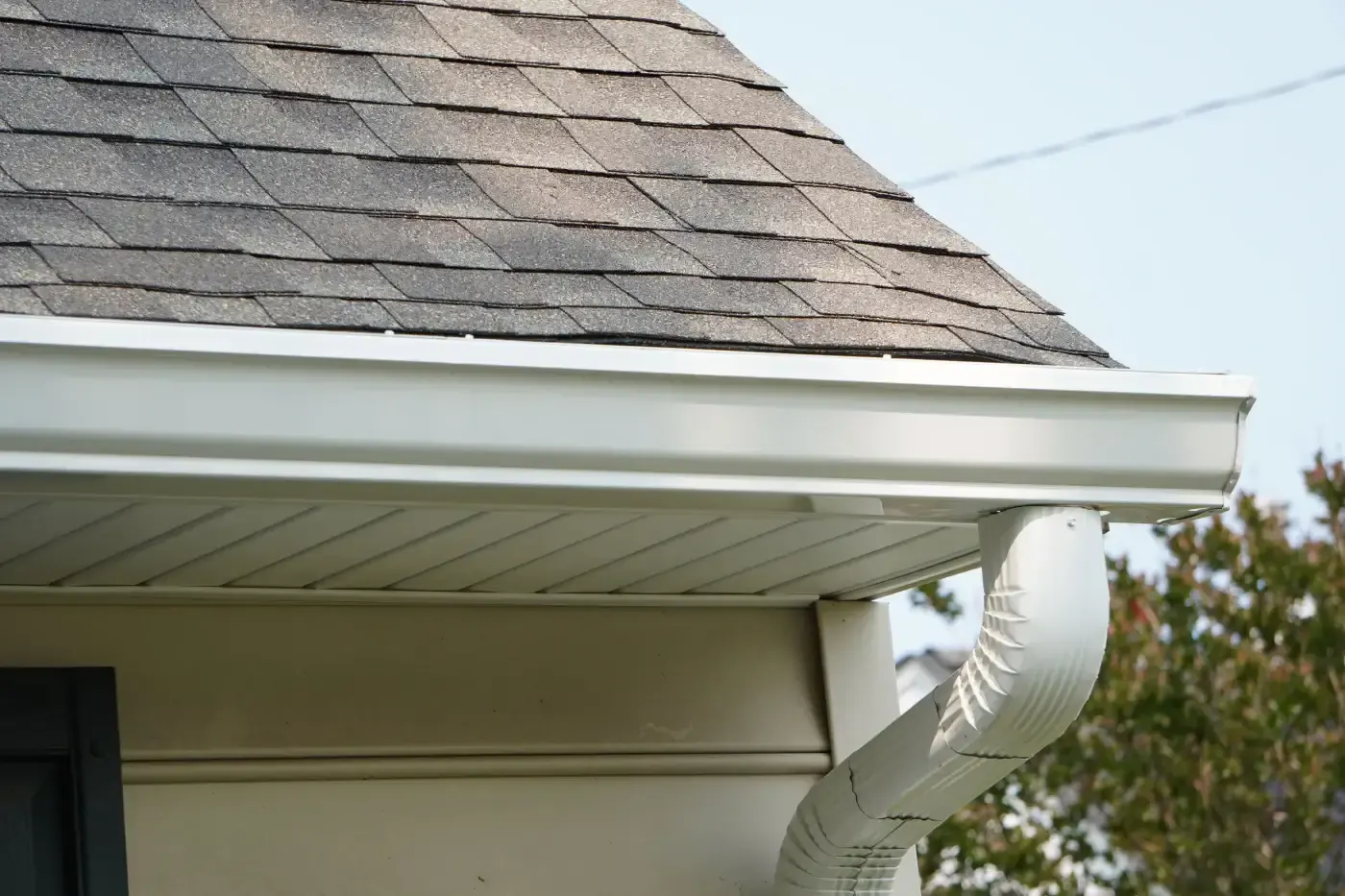
Five-inch and 6-inch gutters can both work in Katy. The correct choice depends on roof catchment, pitch, valleys, rainfall design input, gutter profile, slope, outlet and downspout capacity, and discharge. Six inches can add capacity, but it will not fix clogs, poor slope or an undersized downspout. Compare a measured system plan—not a width-only sales pitch—before selecting a size.
The short comparison
| Decision factor | 5-inch gutters | 6-inch gutters | What still needs to be checked |
|---|---|---|---|
| Typical fit | Smaller or simpler roof sections may be adequately served | Larger catchments or concentrated runoff may justify more capacity | Projected roof area feeding each run |
| Water entry | Can work when roof runoff reaches the trough cleanly | More capacity does not help if valleys overshoot or the roof edge is poorly captured | Roof edge, pitch, valleys and rain direction |
| Outlets and downspouts | Components must match the selected gutter | Larger gutters may need compatible larger outlets and downspouts | Complete flow path and endpoint |
| Appearance | Lower visual profile on some homes | More substantial profile on the roof edge | Profile, fascia, soffit and owner preference |
| Cost | May use less material and smaller components | May cost more because of material and compatible components | Measured scope, access, removal and add-ons |
The table is a decision framework, not a substitute for measurement. A larger trough is not automatically a better system.
Roof catchment matters more than house square footage
Gutter sizing follows the roof area that drains to a specific run—not the home’s living-area square footage. Two homes with the same floor area can have different roof shapes, elevations, valleys and gutter lengths. A compact two-story home may send runoff to fewer, larger roof sections than a sprawling one-story home.
A size review should identify:
- each roof plane feeding a gutter run;
- pitch and the direction of concentrated flow;
- inside corners and valleys that can add sudden volume;
- run length and planned slope;
- corners, end caps and outlet locations; and
- the downspout and discharge path serving each outlet.
This is why “we always install 6-inch” is not an explanation. The recommendation should connect the size to the property’s water path.
Katy rainfall context
Katy’s sudden downpours make capacity planning worth discussing, but a city-level rainfall fact does not prescribe one gutter size for every roof. A NOAA Atlas 14 point query near central Katy returned an estimated 2.17-inch depth for a 2-year, 60-minute event and 4.56 inches for a 100-year, 60-minute event on July 21, 2026. Those are point precipitation-frequency estimates, not a forecast or a promise about a particular home.
Use rainfall as one design input with roof catchment, pitch, valleys, outlets, downspouts and discharge. The heavy-rain gutter guide explains the complete path in more detail.
Outlets and downspouts can be the limiting factor
Water capacity is only as strong as the narrowest part of the system. A gutter can be wide enough while an outlet, elbow, downspout or buried endpoint restricts flow. A clogged downspout can make either 5-inch or 6-inch gutters overflow. A poor discharge endpoint can send water back toward the wall even when the roof edge is captured correctly.
Ask the estimate to identify:
- outlet count and dimensions;
- downspout count, dimensions and locations;
- whether valleys receive dedicated capture or added capacity;
- extension or splash-block requirements; and
- where discharged water will go during sustained rain.
Review downspout and drainage planning before treating gutter width as the entire drainage decision.
When 5-inch gutters may be sufficient
A 5-inch system may be reasonable when the roof area feeding each run, pitch, valley concentration, outlet spacing and downspout capacity fit the system. It may also suit a property where the profile, fascia, roof edge and appearance call for a smaller trough. “Smaller” does not mean inadequate when the complete path is sized and installed for the measured conditions.
The estimate should still explain how intense rain, roof valleys and the discharge point were considered. If overflow has happened before, document where it occurs rather than assuming a new width will solve it.
When 6-inch gutters may be justified
A 6-inch system may deserve comparison when roof sections feed a larger catchment, valleys concentrate water, the property has long runs, the existing system repeatedly overflows despite being clean, or the selected profile and downspouts need additional capacity. The recommendation should show what changes besides the trough: outlets, downspouts, corners, hangers, fascia attachment, removal and discharge.
Six-inch gutters are not overflow-proof. Poor slope, blocked outlets, roof-edge splash, inadequate downspouts and endpoint backups can still create problems.
Compare the estimate, not only the width
Before approving work, compare proposals using the same checklist:
- Measured linear footage by run and elevation.
- Gutter size, profile, material, finish and any thickness or gauge specification.
- Corners, end caps, outlets, hangers and fasteners.
- Downspout dimensions, locations, elbows, extensions and endpoints.
- Removal, disposal, fascia or roof-edge exclusions and cleanup.
- Price, payment terms, change orders and product or workmanship documents.
The gutter cost guide explains how to normalize estimates. Request a Katy gutter estimate when you want the size recommendation tied to the property rather than a generic package.
Frequently asked questions
Does every Katy home need 6-inch gutters?
No. Katy rainfall makes capacity planning important, but roof catchment, pitch, valleys, outlets, downspouts and discharge differ by property. A measured system review should determine the size.
How much more water can a 6-inch gutter carry?
There is no single universal percentage. Capacity depends on the gutter profile, slope, roof area, rainfall input, outlet size and downspout path. Compare the complete system rather than applying a width-only rule.
Can 5-inch gutters work during heavy rain?
Yes, when the roof catchment and complete flow path fit the system. Heavy rain can still overwhelm a clean 5-inch system if valleys, outlets, slope, downspouts or discharge are not adequate.
Do 6-inch gutters require larger downspouts?
Not in every design, but the outlet and downspout should be compatible with the selected gutter and projected flow. The proposal should list their dimensions and locations.
Can adding a downspout help more than changing gutter size?
Sometimes. If overflow is caused by a long run, concentrated valley or restricted outlet, additional or better-placed downspouts may address the bottleneck. The cause should be identified before changing components.
Will 6-inch gutters prevent overflow?
No. Clogs, poor slope, roof-edge capture, valley concentration, restricted outlets, undersized downspouts and discharge backups can affect either size.
What should I ask for in a gutter-size estimate?
Ask for roof catchment by run, pitch and valley considerations, gutter size and profile, outlet and downspout dimensions, discharge endpoints, exclusions, price and written change-order terms.
Sources
- NOAA Atlas 14 precipitation-frequency point query near central Katy
- SMACNA Downspout & Gutter Sizing Calculator
- International Code Council: 2021 IPC Section 1106, Storm Drainage
- NRCA: Design of Roof Drainage Systems
Content review date: August 8, 2026.