
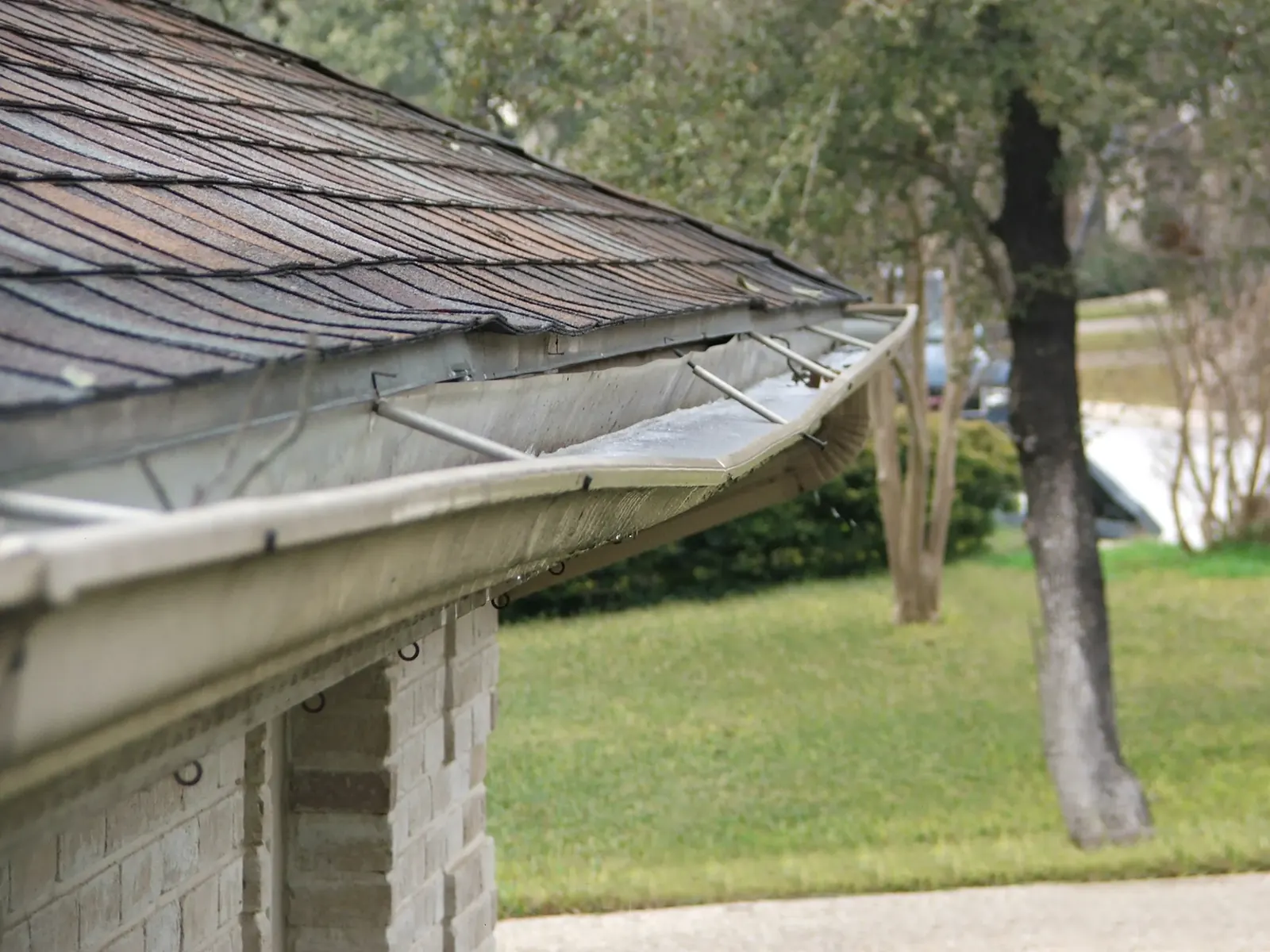
Gutter repair in Katy should begin with the water path, not a quick patch. A leak, sag, overflow or loose downspout can come from a failed connection, poor slope, damaged attachment, debris, inadequate capacity or a downstream restriction. Katy Gutter Pros evaluates the visible symptom and compares localized repair, partial replacement and system-wide changes. Call (281) 652-8877 to discuss an inspection estimate.
Common gutter problems and what they may mean
The visible symptom is not always the cause. Sealant over a leaking corner will not correct a low point, and cleaning will not correct a gutter that is too small for the roof catchment. An effective repair review follows water from the roof edge through the gutter, outlet and downspout to the discharge point.
| What you see | Possible causes to check | What a repair scope should document |
|---|---|---|
| Leak at a corner or end cap | Failed seal, movement, corrosion, impact or standing water | Connection condition and surrounding material |
| Standing water | Low point, poor slope, settlement, debris or outlet placement | Run direction, low point and nearest outlet |
| Sagging or pull-away | Loose hanger, failed fastener, deformed gutter or weak fascia | Attachment points and substrate condition |
| Front-edge overflow | Clog, restricted outlet, valley concentration, poor slope or capacity | Roof area, valley, outlet and downspout conditions |
| Water behind the gutter | Roof-edge capture, drip edge, fascia or roof-covering issue | Boundary between gutter work and roofing/carpentry |
| Crushed or disconnected downspout | Impact, movement, failed strap or blocked route | Full route and discharge endpoint |
When localized repair may be practical
A targeted repair can make sense when the failure is isolated, the surrounding gutter is serviceable and the attachment surface is sound. Depending on the condition, a repair scope may include:
- resealing a verified failed connection;
- replacing an end cap, outlet or short damaged component;
- correcting a localized hanger or fastener failure;
- reconnecting or replacing a damaged elbow or downspout section;
- clearing a verified outlet or downspout blockage; or
- correcting a limited low point when the run geometry permits it.
The estimate should explain why the work addresses the cause rather than covering the symptom. If the same location has failed repeatedly, ask what changed in the diagnosis or design.
When replacement or redesign deserves comparison
Replacement is not automatically required because a gutter is old or has one leak. It becomes more reasonable when the defect is widespread or a repair would leave the underlying system problem in place.
| Condition | Repair may fit | Replacement or redesign may fit |
|---|---|---|
| One leaking joint | Nearby metal is sound and the slope is correct | Multiple joints repeatedly separate or leak |
| Local sag | One attachment point failed and fascia is sound | Deformation or pull-away extends across long runs |
| Corrosion | Small isolated area with serviceable surrounding material | Widespread thinning, holes or incompatible patches |
| Overflow | A clog or restricted outlet is confirmed | Catchment exceeds gutter, outlet or downspout capacity |
| Storm impact | Damage is cosmetic and flow remains open | Dents, open connections or hangers affect the system |
| Repeat service | The cause can be corrected locally | Repairs recur because layout, capacity or substrate is unsuitable |
Fascia, soffit, roof edge and drainage boundaries
Gutters need an appropriate attachment surface. A loose hanger may be gutter repair, but softened fascia, deteriorated wood, displaced drip edge, roof leakage or water entering behind the gutter may require carpentry or roofing work before a secure repair is possible.
Likewise, a downspout repair cannot correct every grading, underground-drainage, foundation or structural condition. Downspout installation and drainage explains where gutter-connected work ends and when another qualified professional may be needed. These boundaries should be written into the proposal before removal begins.
Storm-damaged gutter repair
After wind or hail, wait until conditions are safe and document visible damage from the ground. Look for separated sections, loose downspouts, displaced extensions, dents, debris at outlets and ponding at discharge points. Do not climb a wet ladder or roof to diagnose a problem.
If insurance may be involved, contact the insurer through its stated process and keep photos, estimates and invoices. Coverage depends on policy language, cause of loss, exclusions and deductible. Katy Gutter Pros does not interpret policies or guarantee insurance coverage. Compare an itemized gutter proposal with any adjuster scope and separate roofing, fascia and drainage work.
How the repair review works
- Describe the symptom: Note where and when the leak, overflow, sagging or ponding occurs.
- Review the run: Check joints, end caps, slope, hangers, outlets and the adjacent roof edge.
- Follow the downspout: Check connections, restrictions, damage and the endpoint.
- Identify the cause: Separate debris, component failure, slope, capacity, impact and substrate issues.
- Compare remedies: State whether the scope is localized repair, partial-run replacement or full redesign.
- Approve itemized work: List materials, cleanup, disposal, exclusions, change-order rules and any written terms.
The gutter repair versus replacement guide can help you prepare questions before requesting an estimate.
Repair cost factors
Repair pricing depends on cause and access, not only linear footage. Important variables include stories, roof-edge access, failed connections, material and finish matching, hanger or fastener conditions, downspout components, debris removal, partial-run replacement, fascia or roof boundaries, cleanup and disposal. Ask how concealed damage changes the scope and require approval before added work begins.
Request a gutter repair estimate or contact Katy Gutter Pros with safe ground-level photos and a concise description.
Frequently asked questions
Can a leaking gutter be resealed?
Sometimes. A failed joint or end cap may be resealable if nearby material is sound and standing water, movement or corrosion is not driving the failure. The cause should be evaluated before new sealant is applied.
Why is water standing in my gutter?
Possible causes include a low point, poor slope, settlement, debris or outlet placement. The run should be reviewed before deciding whether it can be adjusted or needs replacement.
Why do clean gutters still overflow?
Clean gutters can overflow when a roof valley concentrates flow, the gutter or outlet is undersized, the slope is poor, the downspout is restricted or discharge backs up.
Can sagging gutters simply be rehung?
A localized attachment failure may be repairable when the gutter and fascia are sound. Widespread pull-away, deformation or deteriorated fascia may require more extensive work or another qualified trade.
Should storm-dented gutters be replaced?
Not always. The decision depends on whether dents restrict flow, open connections, damage the coating or loosen attachment. An on-site review is needed, and insurance coverage should not be assumed.
Is gutter repair different from downspout repair?
They are connected parts of the same roof-water path. A repair review should check the gutter, outlet, downspout and endpoint together so a downstream restriction is not mistaken for a gutter failure.
How do I compare repair and replacement?
Ask what failed, whether the surrounding material and attachment surface are sound, whether capacity or layout contributed to the problem and whether the proposal compares localized repair with partial or full replacement.
How much does gutter repair cost in Katy?
Cost depends on access, cause, components, material matching, partial replacement, cleanup and related fascia or drainage boundaries. A measured or on-site scope is more reliable than a remote flat price.