
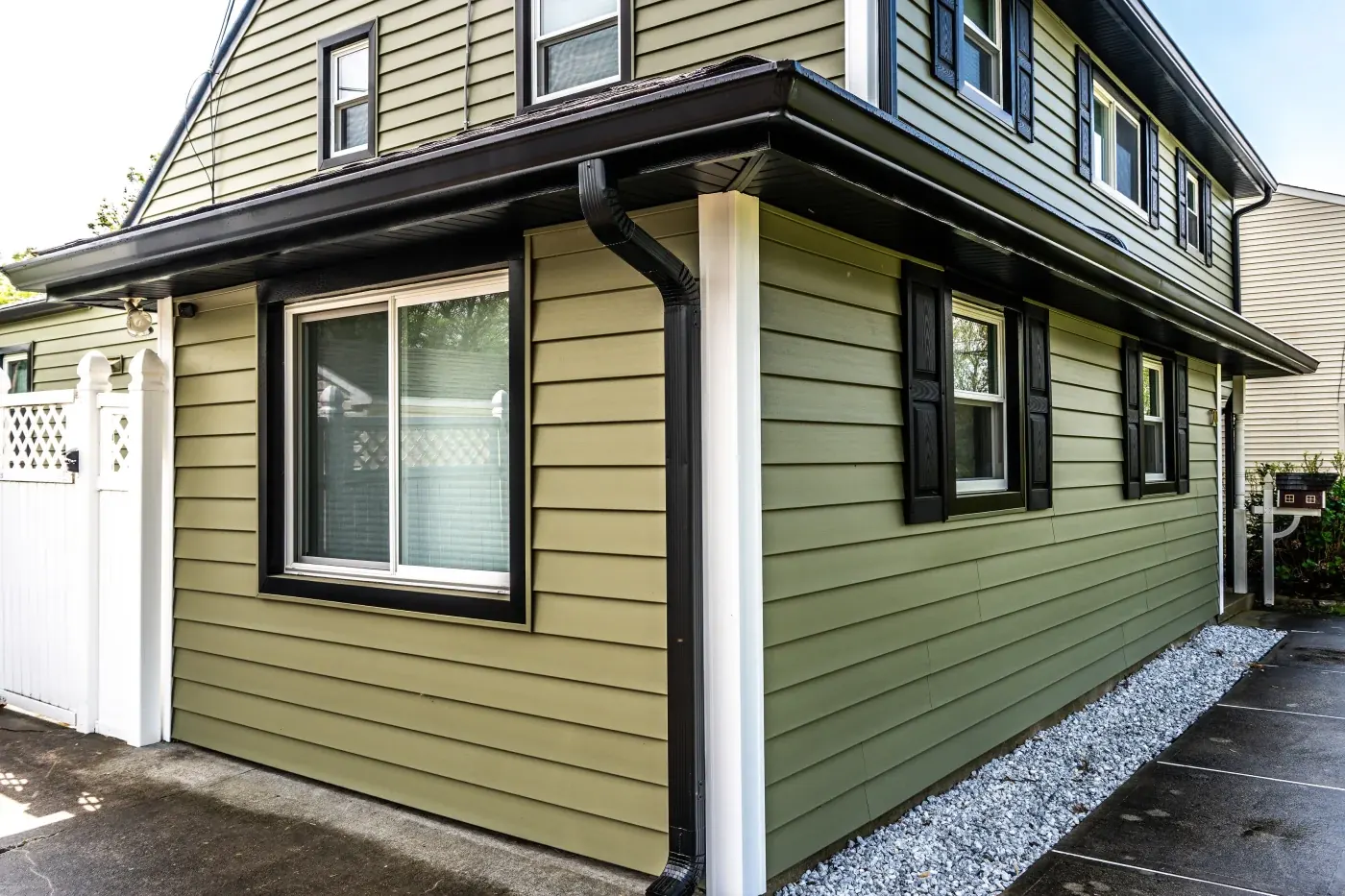
Seamless gutters are formed in long sections to fit a measured roofline, reducing the number of field joints along straight runs. They are not literally joint-free: corners, end caps, outlets and transitions still require connections. Katy Gutter Pros helps Katy homeowners compare seamless gutter sizes, materials, profiles, downspouts and maintenance needs before choosing a complete roof-water system. Call (281) 652-8877 to discuss an estimate.
What “seamless” means
A seamless gutter run is commonly formed to the required length instead of assembled from many short stock sections. Fewer intermediate joints can create a continuous appearance and reduce the number of joint locations along a straight elevation.
Connections still occur at:
- inside and outside corners;
- end caps;
- outlets and downspout connections;
- changes in elevation or profile;
- miters and transitions; and
- sections that must be repaired or replaced later.
The quality of the complete system depends on slope, attachment, outlet design, downspouts, discharge and maintenance—not the word “seamless” by itself. See seamless versus sectional gutters for a broader comparison.
Benefits and limitations
| Consideration | What seamless construction may offer | What still needs to be verified |
|---|---|---|
| Straight runs | Fewer intermediate joints and a continuous look | Corner, end-cap and outlet connections |
| Roofline fit | Long runs can be formed for measured elevations | Accurate measurements and suitable forming capability |
| Leak exposure | Fewer field joints along straight sections | Seal quality, slope, damage, clogs and remaining connections |
| Appearance | Consistent lines with selected profile and finish | Color, downspouts, corners and transitions remain visible |
| Repair | Some localized connections or short sections may be serviceable | A damaged long run may require a larger replacement section |
| Maintenance | Fewer joints do not eliminate debris or inspection | Gutter bodies, outlets, downspouts and guards still need access |
Choosing a size for Katy rainfall
Neither 5-inch nor 6-inch seamless gutters is automatically correct for every Katy home. The decision should account for the projected roof area feeding each run, roof pitch, valleys, rainfall intensity, run length, gutter slope, outlet placement, downspout capacity and discharge conditions. A larger gutter cannot correct a blocked outlet, poor roof-edge capture or a backed-up endpoint.
The SMACNA sizing calculator provides a framework that connects roof area and local rain intensity to gutters and downspouts. A manufacturer’s capacity comparison can help explain the difference between product sizes, but it is not a prescription for every property. Read the 5-inch versus 6-inch guide before paying for an upgrade.
Material, profile and finish choices
Aluminum is commonly associated with seamless fabrication and broad finish choices. Coated steel may be considered where weight and impact behavior are part of the comparison. Copper offers a distinctive appearance and natural patina but requires careful discussion of joining, fasteners and dissimilar-metal compatibility. Sectional vinyl or plastic products have different joint, movement and component considerations.
K-style and half-round describe shape, not quality. The proposal should identify the profile, width, material, thickness or gauge, finish, hanger system, fasteners, corners, outlets and compatible downspouts. Availability depends on the actual product line and installer capability. If an HOA regulates colors or exterior profiles, verify its requirements before work.
Downspouts make the system work
A seamless run still overflows if water cannot leave efficiently. The gutter, outlet, downspout, elbows, straps, extensions and endpoint should be planned together. Downspout installation and drainage is especially important for properties with narrow side yards, driveways, patios, walkways, low areas or visible ponding.
Ask for the written proposal to show the number and dimensions of downspouts, where each outlet is located, how elbows and offsets are handled and where each extension terminates. Underground drainage, grading and foundation work should be separated from the gutter scope when they require a different specialist.
What to compare in a seamless-gutter estimate
A useful proposal should include:
- measured linear footage by elevation;
- projected roof area and valley concentration considered;
- profile, width, material, thickness or gauge and finish;
- corners, end caps, outlets and transitions;
- hanger, fastener and sealant approach;
- downspout count, dimensions, locations and endpoints;
- removal, disposal and cleanup;
- fascia, soffit, drip-edge and roof-work boundaries;
- permit and HOA responsibility; and
- any product or workmanship terms offered in writing.
Compare the complete component list rather than a single price-per-foot number. A seamless proposal with larger downspouts, more outlets and removal may reasonably cost more than a proposal that excludes them.
Maintenance and repair
Seamless gutters still collect leaves, needles, roof grit and other debris. Guards may reduce selected debris but do not remove the need to inspect the surface, gutter body, outlets and downspouts. If one connection leaks or a short section is damaged, repair may be possible when the surrounding material and attachment surface are sound. Widespread corrosion, deformation or repeated separation may justify a broader replacement review.
Request a seamless gutter estimate or contact Katy Gutter Pros with the roofline, problem area and any photos taken safely from the ground.
Frequently asked questions
Are seamless gutters completely seam-free?
No. Straight runs have fewer field joints, but corners, end caps, outlets and transitions still require connections. Those locations can leak if damaged, poorly joined or not maintained.
Are seamless gutters always better than sectional gutters?
No. Seamless construction may reduce joints along straight runs, while sectional systems may offer different component and repair choices. Fit depends on roof layout, material, budget, installer capability and maintenance plans.
Can seamless gutters be made in 5-inch and 6-inch sizes?
Products exist in multiple sizes, but actual availability depends on forming equipment and the product line. The correct size should be based on measured roof runoff and complete-system capacity.
Which material is best for seamless gutters in Katy?
There is no universal winner. Compare aluminum, steel and copper by product specification, weight, finish, impact exposure, compatibility, provider capability, appearance and budget.
Can one damaged seamless section be repaired?
Sometimes. An isolated outlet, end cap or connection may be serviceable when surrounding material is sound. Significant damage to a continuous run can require replacement of a larger section.
Do seamless gutters still need cleaning?
Yes. Leaves, needles, roof grit and other debris can collect in the gutter, outlets or downspouts. Guards may reduce selected debris but do not eliminate inspection and maintenance.
What should a seamless-gutter estimate include?
It should identify measured runs, profile, width, material, finish, corners, outlets, downspouts, attachment, removal, cleanup, exclusions and written product or workmanship terms when offered.