
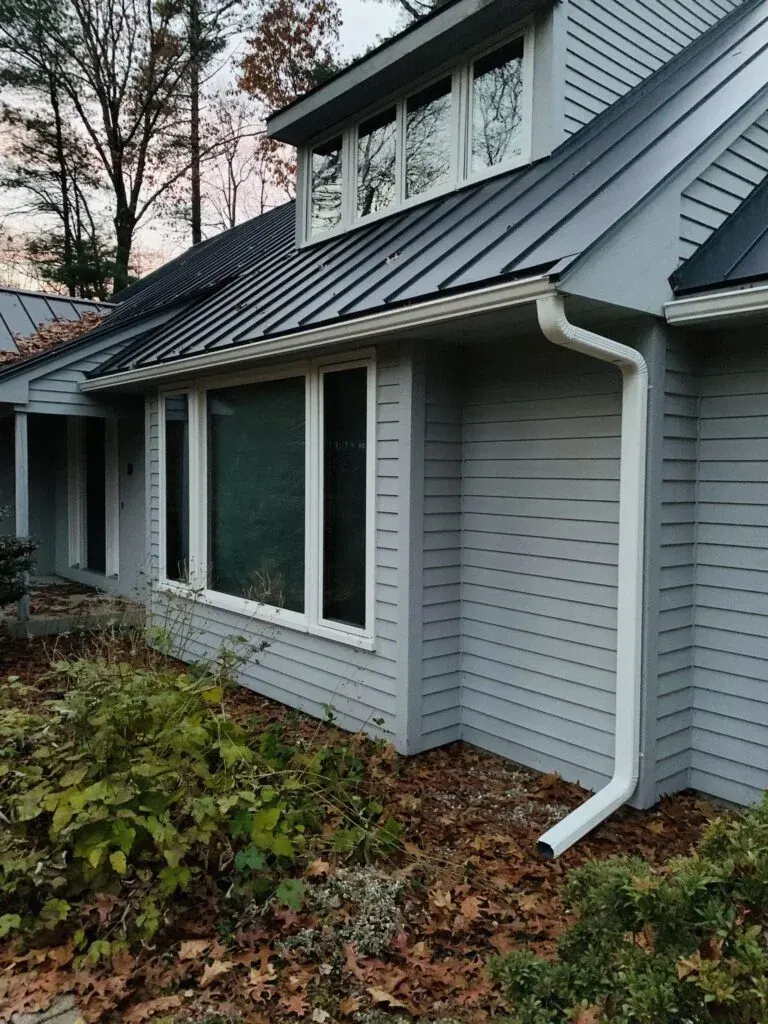
The best gutters for heavy rain are not defined by width alone. Performance depends on roof catchment, pitch and valleys, gutter profile and slope, outlet placement, downspout capacity, debris control and a discharge route that stays open. Katy rainfall supports a calculation-led design, but property measurements and applicable local criteria are required before recommending a size.
Start with the full roof-to-ground path
A residential roof-water system has several linked stages:
Roof surface → gutter edge → gutter run → outlet → downspout → discharge endpoint.
Heavy-rain performance can fail at any stage. Water may overshoot a gutter at a valley, collect behind a leaf screen, sit in a low section, leave through a restricted outlet, back up in a downspout or discharge beside the building. A wider trough does not correct every failure point.
For a property-specific plan, the estimate should show which roof areas feed each run and where the water is intended to go.
Katy rainfall is a design input, not a universal size rule
A NOAA Atlas 14 point query near central Katy returned an estimated 2.17-inch depth for a 2-year, 60-minute event and 4.56 inches for a 100-year, 60-minute event on July 21, 2026. Point precipitation-frequency values describe a statistical rainfall input at a location; they do not forecast a particular storm or prove that every Katy roof needs the same gutter size.
Use the local context with roof geometry, gutter capacity, outlets, downspouts and discharge. A proposal that says only “Katy gets heavy rain” has not explained the design.
Roof catchment, pitch and valleys change the flow
Roof area should be evaluated by the section that drains to each gutter run. Large planes, steep pitches and inside valleys can concentrate more water at one point than a simple eave suggests. A valley may also send water toward a corner or short section that sees more flow than the rest of the elevation.
Ask whether the proposal accounts for:
- roof planes and projected drainage area;
- pitch and valley concentration;
- long runs, corners and planned slope;
- edge capture at fascia and drip edge; and
- outlets placed where the water is actually collected.
If roof-edge or flashing work is outside gutter scope, it should be identified rather than hidden inside a generic “heavy-rain” package.
Size, outlets and downspouts work as one system
| Component | Heavy-rain question | Failure when ignored |
|---|---|---|
| Gutter width/profile | Does the trough fit projected roof flow and profile? | Water rises, spills or bypasses the edge |
| Slope | Can water reach the outlet without ponding? | Standing water and overflow at low points |
| Outlets | Are openings numerous and large enough for the run? | Water backs up before reaching the downspout |
| Downspouts | Are dimensions and locations compatible with the flow? | Gutter appears oversized but still overflows |
| Extensions/endpoints | Does the discharge move water away from problem areas? | Concentrated runoff returns toward walls or paths |
| Debris control | Can leaves and roof grit be managed without restricting entry? | Guards or clogs reduce effective capacity |
The 5-inch versus 6-inch guide explains why width alone cannot select a system. The downspout guide covers the discharge boundary.
Seamless gutters are not a heavy-rain guarantee
Seamless construction reduces field joints along straight runs, which can simplify a continuous roof edge, but corners, end caps, outlets and transitions still have connections. Seamless gutters can overflow when the system is dirty, poorly sloped, under-outletted, undersized for the catchment or connected to restricted downspouts.
Treat construction method, size and drainage capacity as separate decisions. Review seamless gutters for the construction question and gutter repair if the system already shows leaks, sagging or repeated overflow.
Gutter guards require their own heavy-rain check
A guard can reduce selected debris entering a gutter, but a cover can also change how water reaches the trough at valleys and during intense rain. The surface, gutter body, outlets and downspouts all need to be considered. A clean-looking guard demonstration over a short sample does not prove full-roof performance.
Ask for the product and model, compatibility with the gutter and roof edge, attachment method, cleaning access, exclusions and maintenance requirements. Read are gutter guards worth it? before treating leaf reduction as overflow protection.
Discharge is part of heavy-rain performance
Downspouts should terminate at a stable destination that does not send concentrated runoff toward the building, a walkway, a neighboring property or a location that already ponds. Above-ground extensions and splash blocks may be appropriate for some properties. Buried drainage, grading or foundation concerns require separate review and may need another qualified professional.
DOE Building America guidance discusses directing runoff away from foundations, but no gutter system can guarantee protection from flooding, erosion, leaks or foundation movement.
What a heavy-rain estimate should show
Before approving work, look for:
- Roof catchment and valley observations by run.
- Gutter width, profile, material, slope and finish.
- Outlet and downspout dimensions, count and locations.
- Guard product and water-entry considerations if included.
- Extensions, splash blocks or buried drainage scope.
- Removal, fascia, roof-edge, grading and cleanup boundaries.
- Price, payment terms, change orders and written product/workmanship terms.
Request a Katy gutter estimate when you want the complete flow path documented.
Frequently asked questions
Are 6-inch gutters always best for heavy rain?
No. Six-inch gutters may add capacity in some designs, but roof catchment, pitch, valleys, slope, outlets, downspouts and discharge determine whether the system handles projected flow.
Why do my gutters overflow only during intense rain?
Possible causes include valley concentration, limited roof-edge capture, inadequate outlets or downspouts, poor slope, debris, guards that restrict entry or a blocked discharge endpoint. A property review is needed to separate them.
Can adding more downspouts stop heavy-rain overflow?
It can help when the existing run is long or outlet capacity is the bottleneck, but it is not universal. The roof area, gutter slope, outlet placement and endpoint should be reviewed together.
Are seamless gutters better in heavy rain?
Seamless runs have fewer field joints along straight sections, but construction method does not replace sizing, slope, outlets, downspouts and discharge planning.
Do gutter guards help during heavy rain?
They may reduce selected debris, but they do not guarantee overflow prevention. Product water entry, valleys, cleaning access, outlets and downspouts still matter.
Can gutters prevent flooding or foundation damage?
Gutters and downspouts can help manage concentrated roof runoff, but grading, soil, underground drainage, plumbing and structural conditions also affect flooding and foundation performance.
What should a heavy-rain gutter proposal include?
It should identify roof catchment, size/profile, slope, outlets, downspouts, discharge endpoints, debris-control scope, exclusions, price and change-order terms.
Sources
- NOAA Atlas 14 precipitation-frequency point query near central Katy
- SMACNA Downspout & Gutter Sizing Calculator
- DOE Building America: Gutters and Downspouts
- Texas Department of Insurance: Prepare for a Hurricane or Tropical Storm
- NRCA: Design of Roof Drainage Systems
Content review date: August 8, 2026.