
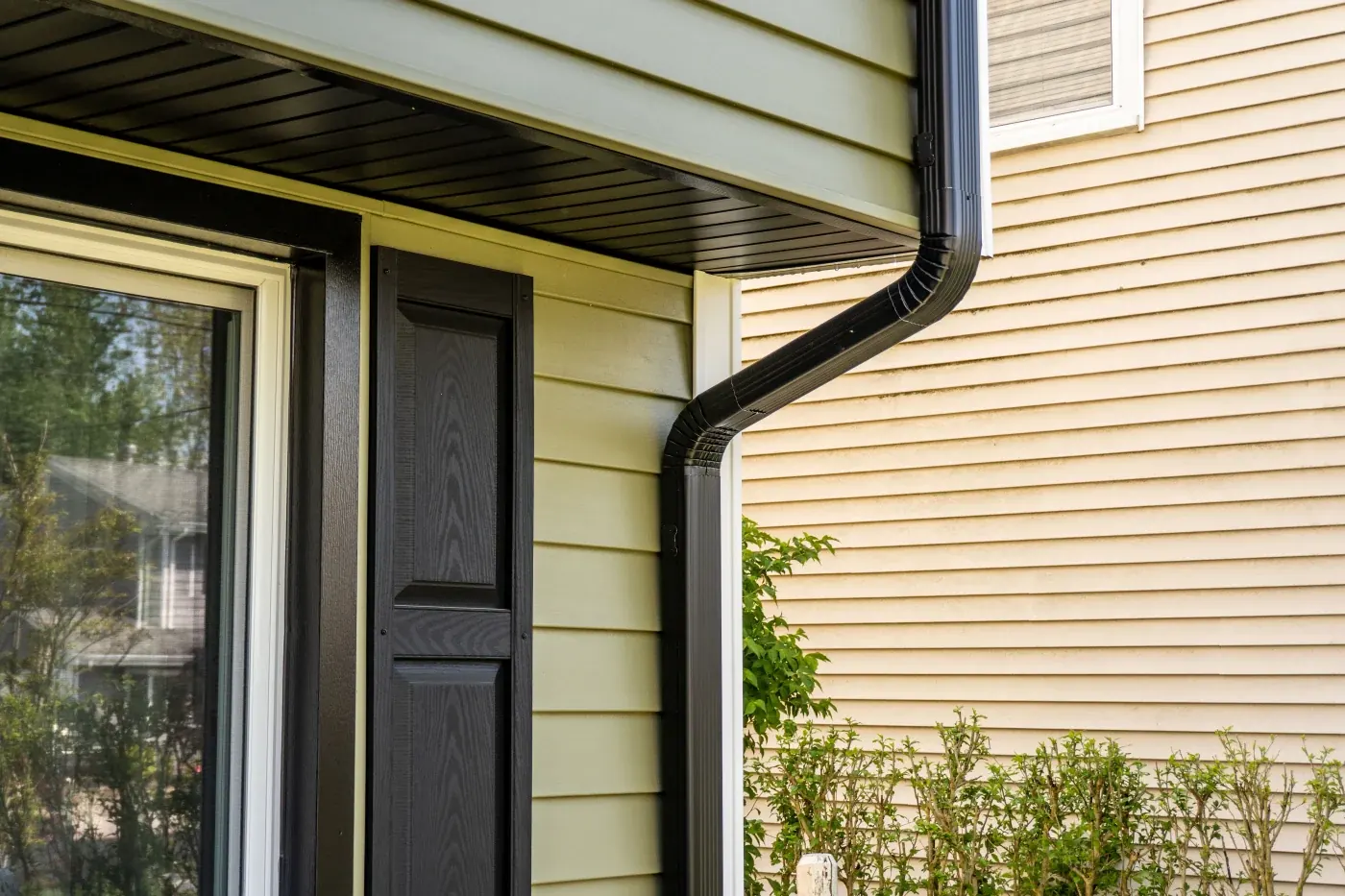
Downspout drainage options include sloped splash blocks, above-ground extensions, solid buried conveyance lines and properly planned rainwater collection. The right choice should move roof runoff to a stable destination without sending it toward the building, a walkway or a neighboring property. Complex grading, underground drainage, erosion or foundation concerns may require a qualified drainage, foundation or engineering professional.
What the discharge plan should accomplish
A downspout is only the vertical part of a longer path:
Roof surface → gutter → outlet → downspout → discharge point.
The endpoint should receive concentrated roof runoff without undermining soil, ponding beside the building, crossing a routine walking path or creating a nuisance for another property. A clean gutter and a working downspout do not prove the endpoint is appropriate.
Katy properties can have different grades, patios, driveways, landscaping, easements and jurisdictional requirements. Review the actual path before choosing a product.
Compare the main options
| Option | Useful when | Limitations and questions |
|---|---|---|
| Splash block | A short, visible discharge can flow across stable sloping grade | It may shift, splash, erode soil or fail where grade runs toward the building |
| Above-ground extension | The endpoint needs to move farther from the wall and remain inspectable | It can cross paths, be damaged by mowing or create a trip hazard |
| Buried solid line | A visible extension is impractical and a stable outlet can be built | Requires slope, cleanouts, suitable outlet, excavation and utility/permit review |
| Rain barrel or collection | The property has a suitable container, overflow plan and safe reuse goal | Capacity is limited; overflow still needs a safe route during heavy rain |
| Specialist drainage solution | Grading, erosion, ponding, underground systems or foundation concerns dominate | May require drainage, foundation, civil or engineering expertise beyond gutter scope |
No option is automatically best. The endpoint and maintenance access decide whether a method is practical.
Splash blocks and above-ground extensions
A splash block can spread water at the bottom of a downspout when the grade directs flow away from the building and the block remains stable. An above-ground extension can move the endpoint farther from the wall, but it should not create a trip hazard, block a walkway or discharge onto a neighboring property.
Check the extension after significant rain. Look for soil washout, ponding, movement, crushed sections, disconnected joints and water returning toward the foundation. Above-ground solutions are often easier to inspect and clean than buried lines, which can be a meaningful maintenance advantage.
Buried drain lines
A buried line can keep a visible extension out of a walkway or patio, but it is not simply a longer downspout. The design needs a route, slope, pipe, connections, cleanout or access plan, outlet and a destination that can accept the flow. A blocked or poorly sloped line can make the gutter system back up or discharge unexpectedly.
Call utility-locate services and check applicable municipal, HOA and property requirements before excavation. A buried roof-runoff line should not be described as a French drain unless the system is actually designed for that function. Grading, soil movement, underground drainage and structural symptoms may require another qualified professional.
Rain barrels and collection
Rainwater collection can be useful when the container, overflow route, base and intended use are appropriate. The container must have enough capacity or a safe overflow path for a storm; otherwise it simply moves the problem to the barrel connection. Keep the discharge away from walls and walking areas, and follow applicable safety and maintenance practices.
Collection is a water-management choice, not a substitute for sizing the gutter, outlet and downspout. The heavy-rain guide explains why the upper part of the system still matters.
Distances and discharge boundaries
DOE Building America guidance describes directing gutters and downspouts at least 5 feet away from foundations to sloping grade or at least 10 feet to an underground catchment in its program guidance. Treat those figures as a referenced design starting point, not a blanket local code rule for every Katy property. Grade, soil, foundation type, local requirements and the actual endpoint still matter.
Gutters can reduce concentrated roof runoff, but they cannot guarantee foundation performance. Persistent ponding, cracking, movement, adverse grade, suspected plumbing leaks or underground drainage problems belong in a separate qualified evaluation.
What to put in a downspout estimate
Ask for a written scope that identifies:
- each downspout and the roof area feeding it;
- extension, splash-block, buried-line or collection method;
- route, slope, endpoint and access/cleanout plan;
- excavation, utility-locate, permit and HOA responsibilities;
- removal, restoration, landscaping and cleanup;
- what happens if concealed drainage or soil conditions are found; and
- price, payment terms, change orders and related-trade exclusions.
Request a downspout estimate or review the downspout service page when the project involves gutter-connected installation or repair.
Frequently asked questions
How far should a downspout extend from the house?
The appropriate distance depends on grade, soil, foundation conditions, local requirements and the endpoint. DOE guidance uses 5 feet to sloping grade or 10 feet to an underground catchment as program references, not a universal local rule.
Is a splash block enough for every Katy home?
No. It may work on stable sloping grade, but it can fail where water ponds, erodes soil, returns toward the building or crosses a walkway.
Is a French drain the same as a downspout drain?
No. A downspout drain conveys roof runoff; a French drain is a broader drainage design with different components and goals. Do not use the terms interchangeably without a defined system.
Can downspouts connect to a rain barrel?
They can when the container, base, overflow route, maintenance and intended use are appropriate. The barrel still needs a safe overflow path for larger storms.
Can an underground line cause gutter overflow?
Yes. A blocked, crushed, poorly sloped or undersized line can restrict discharge and cause water to back up through the downspout and gutter.
Do downspouts prevent foundation damage?
They help move concentrated roof runoff away from the wall, but grading, soil, plumbing, underground drainage and structural conditions also affect foundation performance.
When should I call a drainage specialist?
Consider another qualified professional when the project involves persistent ponding, adverse grading, erosion, buried drainage design, soil movement, foundation symptoms, utilities or structural concerns.
Sources
- DOE Building America: Gutters and Downspouts
- U.S. EPA: Disconnect and Redirect Downspouts
- NOAA Atlas 14 precipitation-frequency point query near central Katy
- City of Katy Permit & Building Services
- Texas Department of Insurance: Prepare for a Hurricane or Tropical Storm
Content review date: August 8, 2026.