
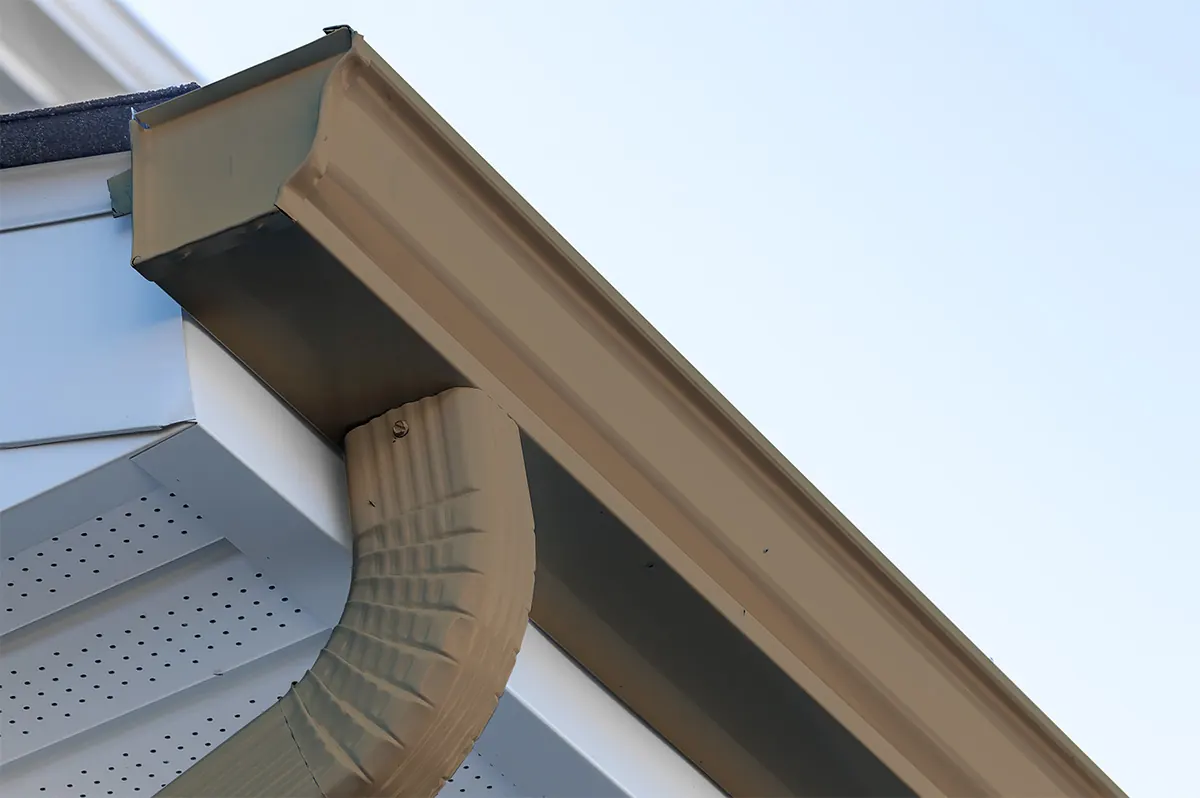
A localized leak, loose hanger or damaged downspout may be worth repairing when the surrounding gutter, attachment and fascia remain sound. Replacement becomes more practical when deterioration is widespread, failures keep returning, or the system is poorly sized for the roof. The right choice requires the gutter, roof edge, outlets, downspouts and discharge path to be reviewed together—not a decision based on age or one visible leak.
Quick decision table
| What you observe | Repair may make sense when | Replacement or redesign deserves comparison |
|---|---|---|
| Leak at a seam, end cap or outlet | The surrounding run is sound and the connection is accessible | Multiple joints or long sections leak repeatedly |
| Sagging or pull-away | Hangers and attachment points can be corrected without damaged substrate | Fascia is deteriorated or the run has widespread deformation |
| Overflow | Debris, one restricted outlet or a local slope issue explains it | Capacity, roof catchment, valleys or outlet layout are wrong across the system |
| Corrosion or dents | Damage is limited and metal remains stable | Corrosion, impact or distortion affects many runs |
| Downspout failure | Connection, strap, elbow or extension is the issue | Downspouts are too few, poorly placed or incompatible with roof flow |
| Repeated patching | One repair addresses an isolated failure | Repair history costs more without correcting the cause |
This table helps organize questions. It does not diagnose the property remotely.
Good repair candidates
Repair is often worth evaluating when the problem is localized and the rest of the system still performs. Examples include a failed seal at a corner, a loose hanger, a detached strap, a damaged elbow, a restricted outlet or a short section affected by a discrete impact. The repair scope should explain why the surrounding gutter and attachment can remain in service.
Ask for photos or measurements that show:
- where water escapes and when it occurs;
- whether the gutter holds standing water;
- how the gutter is attached to fascia or other support;
- whether the outlet and downspout are open; and
- whether water reaches an appropriate endpoint.
A clean repair is not simply a bead of sealant over a symptom. The cause and the surrounding condition matter.
When replacement or redesign deserves comparison
Replacement deserves a closer look when the system has widespread corrosion, repeated pull-away, multiple failed joints, severe dents, long runs with poor slope, inadequate capacity or downspouts that cannot serve the roof catchment. If fascia, soffit, drip edge or roof-edge conditions are damaged, the estimate should separate those scopes instead of assuming new gutters solve the substrate problem.
Replacement can also be a design decision rather than a material decision. A new gutter with the same outlet layout and discharge problem may reproduce the old overflow. Compare roof catchment, valleys, gutter size, slope, outlet locations, downspout dimensions and endpoints before approving a full system.
Repeated overflow is not automatically a replacement problem
Katy downpours can expose a capacity or flow-path issue that looks like gutter damage. Debris, valley concentration, poor slope, limited outlets, restricted downspouts and a blocked discharge point can all cause overflow. Read why gutters overflow before assuming the entire system must be replaced.
If the gutter body is sound but the system is undersized or poorly routed, the right scope might be a targeted redesign, additional outlets, downspout changes or discharge work. If the body and attachment are failing in several places, replacement may be the more coherent option.
Compare total scope, not just price per foot
A repair estimate and a replacement estimate are not comparable unless they identify the same boundaries. Check:
- linear footage and elevations;
- gutter profile, size, material and finish;
- corners, end caps, outlets, hangers and fasteners;
- downspouts, elbows, extensions and endpoints;
- removal, disposal and cleanup;
- fascia, soffit, roof-edge, grading or buried-drain exclusions;
- payment, change orders and product/workmanship documents.
A lower repair total may be temporary if it leaves a capacity or discharge problem. A higher replacement total may be excessive if a local repair resolves the actual cause. The gutter cost guide provides a comparison framework.
How Katy Gutter Pros evaluates the decision
A useful review follows a repeatable sequence:
- Document the symptom and the conditions when it occurs.
- Review the gutter run, joints, end caps, slope, hangers and visible attachment.
- Follow outlets, downspouts and extensions to the discharge point.
- Identify roof-edge, fascia, soffit, grading or structural boundaries.
- Compare localized repair, partial replacement and broader redesign.
- Approve only an itemized scope with price, exclusions and change-order terms.
Request a gutter estimate when you want a property-specific repair-versus-replacement conversation.
Frequently asked questions
Does a leaking gutter always need replacement?
No. A localized seam, end cap or outlet leak may be repairable when surrounding metal, attachment and fascia remain sound. Widespread or recurring failure deserves a replacement comparison.
Can one gutter run be replaced without replacing everything?
Sometimes. Partial replacement depends on material compatibility, connections, condition of adjacent runs, slope, outlets, fascia and whether the larger system still works.
Should gutters be replaced with the roof?
Not automatically. Roof work and gutter work interact at the edge, but the gutter decision should follow the actual condition, attachment, roof-edge scope and runoff design.
Can clean gutters still need replacement?
Yes. Cleaning removes debris but does not correct inadequate capacity, failed slope, widespread corrosion, damaged attachment, poor roof-edge capture or bad outlet layout.
Is repair always cheaper than replacement?
Usually a localized repair has a smaller immediate scope, but repeated repairs can cost more without correcting the cause. Compare the expected scope and recurring failure risk rather than price alone.
Can gutter repair fix fascia or structural damage?
Gutter work may identify fascia, soffit, roof-edge or structural concerns, but those conditions should be separated and assigned to the appropriate qualified professional.
What should a repair-versus-replacement estimate include?
It should identify the observed problem, proposed remedy, measurements, components, removal, cleanup, related-trade exclusions, price, payment terms, changes and any written product or workmanship terms.
Sources
- NOAA Atlas 14 precipitation-frequency point query near central Katy
- DOE Building America: Gutters and Downspouts
- Texas Department of Insurance: Home Damaged by Storm FAQ
- U.S. Consumer Product Safety Commission: Outdoor Repairs Safety Checklist
Content review date: August 8, 2026.