
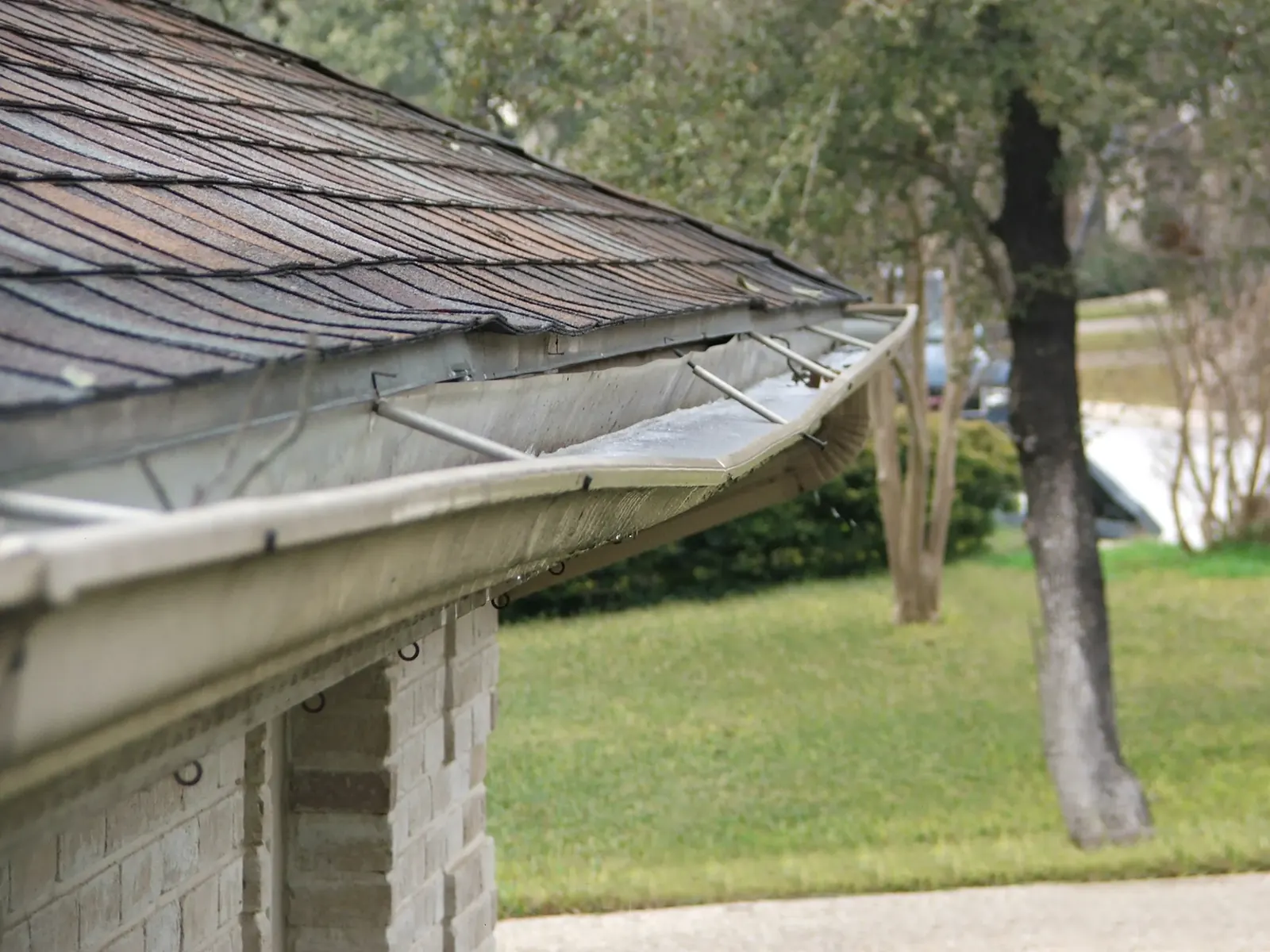
Gutters overflow when water cannot enter, travel through or leave the roof-water system quickly enough. Common causes include debris, poor slope, concentrated valley flow, inadequate capacity, restricted outlets, undersized or damaged downspouts, blocked discharge and roof-edge capture problems. The visible spill is a symptom; the right repair depends on where the flow path is failing.
Match the symptom to the likely inspection point
| What you see | Possible cause to investigate | What not to assume |
|---|---|---|
| Overflow only at one corner | Valley concentration, corner joint, short outlet run or poor slope | The entire system is too small |
| Water spills along a long straight run | Debris, low point, inadequate slope or roof catchment | A single sealant patch will solve it |
| Overflow during intense rain only | Capacity, roof catchment, outlets, downspouts or valley flow | Normal rain means the system is correctly sized |
| Water rises in a clean gutter | Restricted outlet, downspout or endpoint | Cleaning alone will fix it |
| Water pours over the front edge | Roof-edge capture, pitch, guard behavior or high flow | A guard always improves performance |
| Water exits near the wall below a downspout | Extension, buried line or discharge backup | The gutter body is the only problem |
The pattern narrows the questions, but it does not replace a property review.
1. Debris blocks the first link
Leaves, needles, seed pods, roof grit and sediment can restrict the gutter body, outlet or downspout. Cleaning may restore flow when debris is the only problem. It does not correct poor slope, inadequate capacity, damaged attachment or a blocked buried endpoint.
If overflow follows a predictable leaf season, inspect the gutter, outlets and downspouts before adding guards or replacing the system. The gutter cleaning page covers scope and maintenance; how often gutters should be cleaned covers schedule decisions.
2. Poor slope or damaged attachment creates a low point
Gutters need a planned slope toward outlets. Pull-away, loose hangers, damaged fascia or a sagging run can create standing water and overflow at a low point. Water that remains after debris is removed points toward a slope or support question rather than a simple cleaning question.
Attachment repairs may be limited when the substrate is sound. If fascia or roof-edge material is deteriorated, the estimate should identify that boundary and avoid presenting new hangers as a structural repair.
3. Roof catchment or gutter capacity may not fit
A roof can send more water to a gutter run than the original layout anticipated. Large roof sections, steep pitches and valleys concentrate flow. The issue may involve gutter size, profile, slope, outlet count or downspout capacity—not just the trough width.
The 5-inch versus 6-inch guide explains why a larger gutter is not automatically the answer. A complete review should map each roof area to its run and outlet.
4. Valleys can overwhelm a normal-looking run
An inside valley can concentrate roof runoff at a corner or short gutter section. That section may overflow even when the rest of the elevation performs normally. Look for splash marks, staining, erosion or overflow that begins at the same valley during rain.
Possible responses depend on the roof edge and system: better capture, added capacity, outlet changes, downspout changes or work outside ordinary gutter scope. Do not select a universal fix without examining the roof-to-gutter transition.
5. Outlets, downspouts and endpoints can back up
A gutter can be clean and correctly sloped while water still overflows because an outlet is restricted, a downspout is damaged or an extension or buried line cannot move the discharge. Check where water leaves the gutter and where it ends on the property.
The downspout and drainage page covers gutter-connected discharge. Persistent ponding, adverse grading, underground drainage, plumbing or foundation symptoms may need a different qualified professional.
6. Guards can change water entry and maintenance
Gutter guards can reduce selected debris, but a cover is not a capacity upgrade by itself. Its surface, slope, valleys, roof edge, cleaning access, outlets and downspouts all matter. A guard may also conceal a dirty gutter or unresolved defect if the system is not inspected after installation.
Read are gutter guards worth it? before treating leaf reduction as an overflow solution.
Safe troubleshooting before calling
From the ground, note where overflow begins, whether it occurs in ordinary or intense rain, whether it follows a valley, and whether the downspout endpoint ponds. Take photos from a safe location. Do not climb a wet roof or ladder to chase a diagnosis.
A clear repair request includes the property location, story count, symptom location, recent storm or roof work, tree conditions and any known cleaning or repair history. Request a Katy gutter estimate for a scope that distinguishes cleaning, repair, redesign and related-trade work.
Frequently asked questions
Why do gutters overflow only during heavy rain?
Heavy rain can expose roof catchment, valley concentration, gutter capacity, outlet, downspout or discharge limitations that are not visible during light rain. Debris and poor slope can also contribute.
Can cleaning stop gutter overflow?
Cleaning can help when debris is restricting the gutter, outlet or downspout. It will not correct poor slope, inadequate capacity, damaged attachment, roof-edge capture or a blocked discharge endpoint.
Why do my gutters overflow at one corner?
A valley, corner joint, short run, poor slope, restricted outlet or concentrated roof section may be involved. The pattern should be inspected rather than assuming every gutter needs replacement.
Will 6-inch gutters stop overflow?
Not necessarily. A larger gutter cannot correct poor slope, blocked outlets, undersized downspouts, valley splash, roof-edge bypass or discharge backup.
Can gutter guards cause overflow?
They can contribute if water entry, debris, roof geometry, product fit or maintenance access is not appropriate. Guards should be evaluated with the gutter, outlets and downspouts.
Can a downspout extension fix overflowing gutters?
An extension can improve the endpoint and reduce runoff near the wall, but it cannot fix a gutter that is overflowing before the downspout or a blocked line.
When should I replace gutters because of overflow?
Replacement deserves comparison when overflow reflects widespread corrosion, poor sizing, repeated failures or a system-wide design problem. A localized clog, slope or outlet issue may support repair instead.
Sources
- NOAA Atlas 14 precipitation-frequency point query near central Katy
- SMACNA Downspout & Gutter Sizing Calculator
- DOE Building America: Gutters and Downspouts
- Texas Department of Insurance: Prepare for a Hurricane or Tropical Storm
- U.S. Consumer Product Safety Commission: Outdoor Repairs Safety Checklist
Content review date: August 8, 2026.