
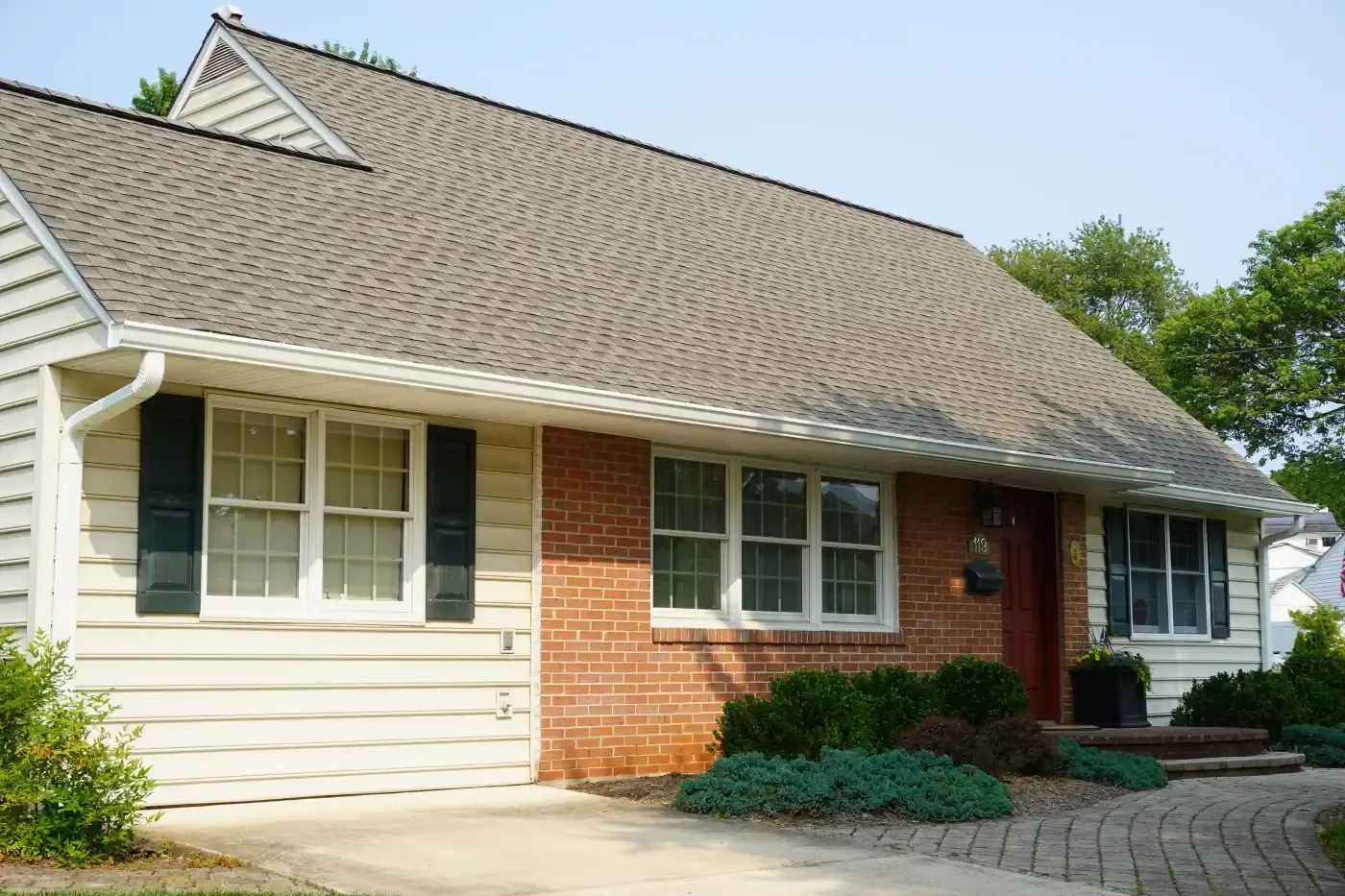
K-style and half-round gutters are different profiles, not automatic quality grades. K-style gutters have a more angular, often decorative face and are common on many modern homes. Half-round gutters have a rounded trough and a more traditional appearance. The right profile depends on the roof edge, fascia, material, width, hangers, outlets, downspouts, maintenance access and architectural fit—not the shape name alone.
Quick comparison
| Decision factor | K-style | Half-round | What the estimate should confirm |
|---|---|---|---|
| Cross-section | Angular or shaped back and face | Rounded trough | Exact profile and nominal width |
| Appearance | Often blends with contemporary trim and common residential details | Often suits traditional, historic or architectural designs | HOA or exterior-design requirements |
| Capacity | Profile dimensions and slope determine usable capacity | Rounded geometry and outlet size determine flow | Roof catchment, valleys and rainfall input |
| Hangers | Uses profile-specific hangers or hidden supports | Often requires compatible brackets or hangers | Attachment to fascia, rafter tails or other structure |
| Materials | Aluminum, steel, copper and other product lines may exist | Availability varies by material and manufacturer | Confirm actual material and fabrication capability |
| Cleaning | Corners and shaped faces can collect debris | Rounded trough is visible but still collects debris | Safe access and future service plan |
| Cost | Varies with material, width, corners and access | May carry different component and fabrication costs | Measured, itemized scope |
A profile comparison is not a substitute for sizing the entire roof-water path.
K-style gutters: familiar shape, many configuration choices
K-style gutters are recognizable by their shaped front edge and relatively angular channel. That face can coordinate with fascia and trim, and the profile is available in multiple materials, widths and finishes. The visible shape does not identify the thickness, attachment method, outlet size or downspout capacity.
Ask which dimensions are being quoted, whether the gutter is formed seamless or assembled in sections, how corners and outlets are made, and which hangers support the run. A larger-looking front can still be paired with an inadequate outlet or restricted downspout.
Half-round gutters: rounded profile, specific hardware
Half-round gutters use a curved trough and can provide a distinctive traditional appearance. The profile may be a good architectural fit where rounded lines, exposed brackets or a particular material are desired. The complete system still needs compatible end caps, corners, outlets, hangers and downspouts.
Half-round does not automatically mean higher capacity, lower maintenance or better flow. Confirm the actual cross-section, slope, outlet design and component availability. If a property has unusual fascia, rafter tails, masonry or metal-roof trim, the attachment plan matters as much as the trough.
Capacity, roof geometry and downspouts
Profile is only one sizing input. The proposal should account for roof area feeding each run, pitch, valleys, long eaves, rainfall intensity, gutter slope, outlet placement and downspout dimensions. The 5-inch versus 6-inch guide explains why width alone cannot choose a system, and the seamless gutter service page covers construction and component choices.
A K-style or half-round gutter can overflow when the outlet is too small, the downspout is restricted, a valley concentrates water, a low point holds water or the discharge path backs up. The shape does not eliminate those failure modes.
Materials, hardware and maintenance
Aluminum, coated steel, copper and sectional products behave differently around weight, corrosion, finish, compatibility and repair parts. Profile-specific hangers and fasteners must match the material and attachment surface. Review the gutter materials guide before comparing a copper half-round proposal with an aluminum K-style proposal as if the only difference were appearance.
Both profiles need debris inspection, outlet checks and downspout maintenance. A guard can change access and water entry. Cleaning frequency depends on trees, roof grit, storms and prior clogs rather than profile alone.
Cost and selection questions
The gutter cost guide explains why a price-per-foot comparison can mislead. Ask for measured footage, profile, width, material, finish, thickness or gauge, corners, end caps, outlets, hangers, downspouts, removal, fascia or roof-edge exclusions, cleanup and written product/workmanship terms.
Request a measured gutter estimate when the profile decision needs to be tied to the roof and attachment conditions. Choose the profile that fits the property and can be maintained—not simply the one with the more familiar name. For installation context, compare gutter installation with seamless versus sectional construction.
Frequently asked questions
Are K-style gutters better than half-round gutters?
Neither profile is universally better. Compare architectural fit, roof catchment, width, slope, outlets, downspouts, attachment, material, maintenance and cost.
Do half-round gutters hold less water?
Capacity depends on the actual profile dimensions, slope, rainfall, roof catchment and outlets. Do not apply a universal capacity conclusion from the shape name.
Are K-style gutters only available in aluminum?
No. Product availability varies. Aluminum, coated steel, copper and other systems may be available, but the exact material and installer capability should be confirmed.
Are half-round gutters more expensive?
They can involve different materials, hardware, fabrication and installation requirements, but cost depends on the measured scope, not profile alone.
Which profile is easier to clean?
Neither is maintenance-free. Debris, roof access, guards, outlet placement and safe service access matter more than assuming one shape never needs attention.
Can K-style and half-round gutters use the same hangers?
Usually the hardware must match the profile and attachment method. Confirm compatible hangers, fasteners, corners and outlets in the estimate.
What should a K-style or half-round estimate include?
It should identify measured runs, profile, width, material, finish, hardware, corners, outlets, downspouts, removal, exclusions, cleanup, price and written terms.
Sources
- SMACNA Downspout & Gutter Sizing Calculator
- NRCA: Design of Roof Drainage Systems
- NOAA Atlas 14 precipitation-frequency point query near central Katy
- GAF Technical Bulletin: Corrosion of Aluminum Gutters and Flashings
Content review date: August 8, 2026.