
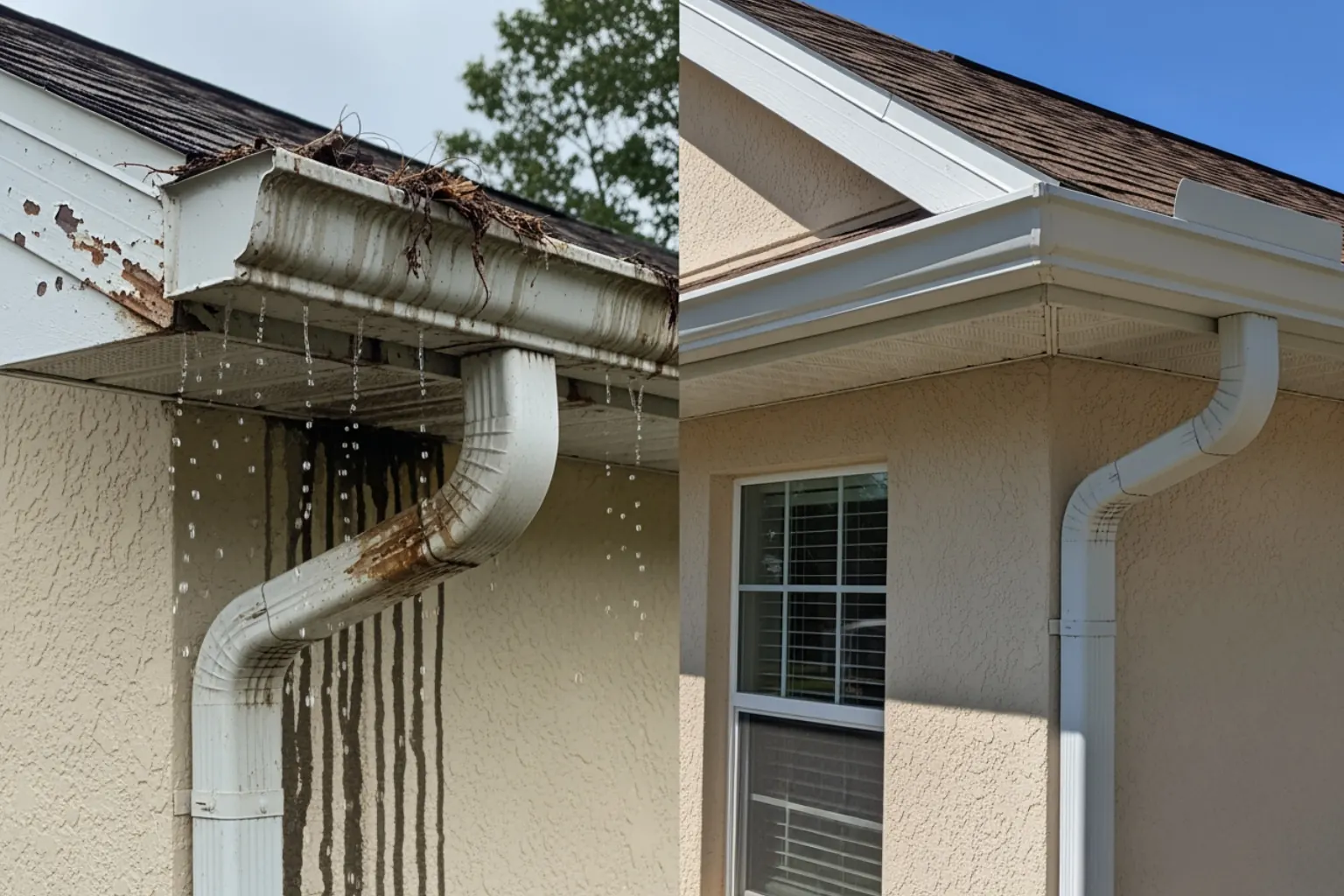
Seamless gutters are formed in long sections to fit a measured roofline, reducing the number of field joints along straight runs. Sectional gutters use shorter pieces connected at more locations. Seamless construction can create fewer straight-run joints and a continuous appearance, while sectional systems can simplify transport, replacement of short pieces and some repairs. Neither choice is leak-proof or universally better; roof layout, material, installation and maintenance decide performance. For service context, compare seamless gutter installation with complete gutter installation, and review why gutters overflow when performance is the concern.
Quick comparison
| Decision factor | Seamless gutters | Sectional gutters | What to confirm |
|---|---|---|---|
| Straight runs | Formed in longer, measured sections | Built from shorter manufactured pieces | Run length, access and fabrication capability |
| Joint locations | Fewer joints along straight sections | Joints wherever sections connect | Corners, end caps, outlets and transitions remain connections in both systems |
| Fabrication | Often requires forming equipment and a property-specific measurement | Uses standard lengths and connectors | Actual product and installation scope |
| Repair approach | A damaged long run may require a larger replacement section | A compatible short section may be replaceable | Material, profile, color and parts availability |
| Appearance | More uninterrupted lines on long elevations | More visible connections | Architecture and owner preference |
| Cost drivers | Material, forming, access and complexity | Material, joints, labor and compatible parts | Measured estimate, not a label such as “premium” |
“Seamless” describes how a straight run is constructed. It does not mean every corner, outlet or transition has no joint.
Joints and leak points
Straight-run joints are reduced with seamless construction, but a complete gutter system still has connections at corners, end caps, outlets and transitions. Those locations can leak when they are damaged, poorly joined, stressed by movement or left with failed sealant. Sectional systems have additional joints along the run, which creates more potential connection points but can also make a short, compatible section easier to isolate.
Water management depends on more than joint count. Poor slope, a restricted outlet, debris, an undersized downspout or an endpoint that backs up can create overflow in either construction method. Review why gutters overflow when the concern is performance rather than appearance.
Installation and fabrication requirements
A seamless installation typically requires a forming setup, accurate run measurements, safe access and a plan for moving long sections into place. Sectional installation relies on cutting, joining and supporting individual pieces. The property may favor one approach based on elevation length, access around fences or landscaping, corners, roof geometry, material and available components.
The estimate should document:
- measured footage by elevation and run;
- gutter profile, width, material, finish and component compatibility;
- corners, end caps, outlets, hangers and fasteners;
- downspout count, dimensions, extensions and endpoints;
- removal, disposal and cleanup; and
- fascia, soffit, roof-edge, grading and buried-drain exclusions.
A continuous-looking run does not excuse an incomplete outlet or discharge plan.
Materials, profiles and size are separate choices
Seamless versus sectional describes construction, not metal or capacity. Aluminum, coated steel, copper and sectional plastic can involve different weight, appearance, corrosion behavior, maintenance and compatibility questions. K-style and half-round describe profile. Five-inch and 6-inch describe common width choices. Any of these can be paired differently depending on the product and installation method.
Use the gutter materials guide to compare material behavior and the 5-inch versus 6-inch guide to compare capacity inputs. The gutter, outlets and downspouts should be selected as one flow path.
Repairability and maintenance
A seamless run can reduce routine straight-run joints, but a puncture, impact or severe corrosion may affect a larger continuous section. A sectional system can make a compatible short piece easier to replace, but its joints still need inspection and maintenance. Neither system eliminates cleaning, outlet checks or downspout maintenance.
Ask who supplies compatible repair material, how color matching works, what happens if a corner or outlet fails, and whether product or workmanship terms are issued in writing. Do not treat a “lifetime” label as a universal performance promise.
Appearance and cost
Long uninterrupted runs may look cleaner on a long Katy elevation, while sectional connections may be acceptable or preferred for the architecture and budget. Cost depends on material, profile, width, footage, stories, access, corners, downspouts, removal, fascia condition and the number of transitions—not simply on whether the system is called seamless.
The gutter cost guide explains how to compare an itemized proposal. Request a measured gutter estimate when you want the construction method, size, material and drainage scope evaluated together.
Which option may fit a property?
Seamless construction may fit a home where long straight runs, a continuous appearance and available forming capability justify the setup. Sectional construction may fit a smaller or more segmented project, a repair using compatible parts, or a property where transport and component availability matter more.
The right answer is the one that produces a sound, maintainable roof-water path under the property’s conditions. It should not be chosen only because one label sounds more durable.
Frequently asked questions
Are seamless gutters completely seamless?
No. Straight runs have fewer field joints, but corners, end caps, outlets and transitions still require connections.
Are seamless gutters guaranteed not to leak?
No. Leaks can occur at corners, end caps, outlets, transitions, damaged sections, poor joints or attachment points in either system.
Are seamless gutters always better than sectional gutters?
No. Seamless systems may reduce straight-run joints and create a continuous appearance, while sectional systems can offer different transport, repair and component options.
Can seamless gutters be repaired?
Sometimes. An isolated outlet, end cap or connection may be repairable; damage to a continuous run may require replacing a longer section. Material and component compatibility matter.
Do sectional gutters always cost less?
No. Cost depends on material, profile, footage, joints, access, corners, downspouts, removal and scope. Compare itemized proposals rather than construction labels.
Do seamless gutters still need cleaning?
Yes. Leaves, needles, roof grit and other debris can collect in the gutter, outlets or downspouts regardless of construction method.
What should a seamless-versus-sectional estimate include?
It should state measured runs, construction method, profile, size, material, finish, corners, outlets, downspouts, removal, cleanup, exclusions, price and written product or workmanship terms.
Sources
- SMACNA Downspout & Gutter Sizing Calculator
- NOAA Atlas 14 precipitation-frequency point query near central Katy
- NRCA: Design of Roof Drainage Systems
- GAF Technical Bulletin: Corrosion of Aluminum Gutters and Flashings
Content review date: August 8, 2026.