
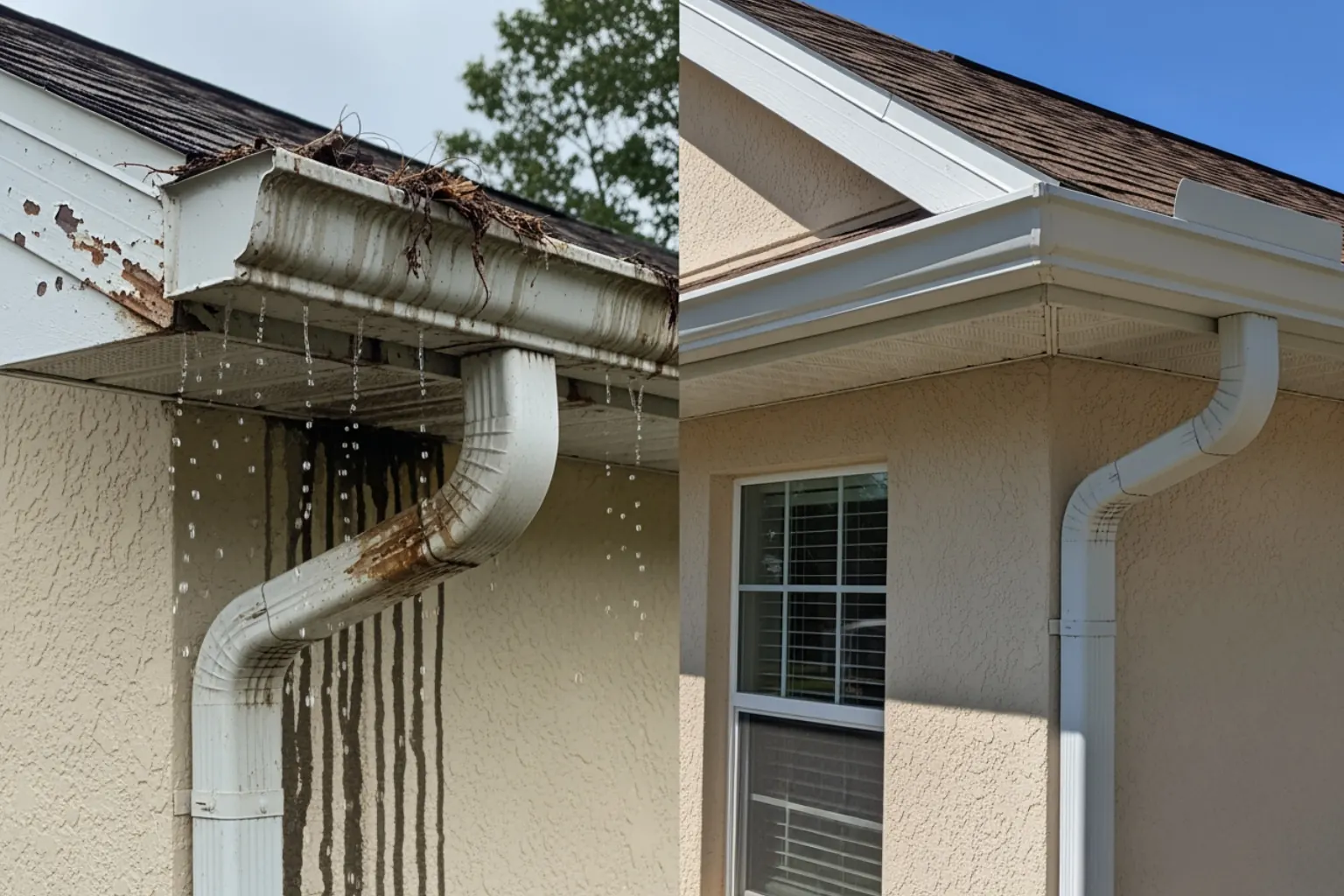
Gutter leaks at seams and corners commonly come from failed joints, damaged sealant, movement, corrosion, impact, poor alignment or water arriving faster than the connection can handle. A seam leak may be localized, but repeated leaks can also reveal sagging, overflow, inadequate outlets or a gutter system that is reaching the end of its serviceable condition. Find the source before treating the symptom.
Where leaks occur
| Location | Possible issue | What else to inspect |
|---|---|---|
| Inside or outside corner | Joint movement, poor fit or failed sealant | Roof valley flow and adjacent slope |
| End cap | Open connection, impact or corrosion | Run alignment and water level |
| Outlet | Failed connection or restricted downspout | Outlet size, elbow and vertical pipe |
| Straight seam | Separation, movement or material damage | Nearby hangers and repeated overflow |
| Behind the gutter | Roof-edge bypass, pull-away or flashing issue | Fascia, drip edge and roof boundary |
| Below a joint | Overflow may be mistaken for a leak | Debris, low point, valley and downspout |
Water can travel along the back or underside of a gutter, so the wettest spot is not always the entry point.
A seam leak is not always a sealant problem
Sealant can fail when a joint moves, the surface is dirty or wet, the material is corroded, the gap is too large or water is repeatedly backing up. Applying new sealant over an active leak without cleaning and aligning the connection may produce a short-lived patch.
A repair review should identify whether the connection is sound, whether the material around it is thinning, whether the run has adequate slope and whether the downspout is open. Gutter cleaning may be appropriate when debris is the cause, but cleaning does not repair an open seam or damaged fascia.
Corners and valleys need extra attention
Corners and valleys receive concentrated water and often contain more fittings than a straight run. A corner can leak because the gutter is out of alignment, the roof edge bypasses the trough, the outlet is restricted or the run has settled. Heavy rain can expose a connection that appears dry in light weather.
Use why gutters overflow to separate a joint leak from a capacity or flow-path problem. If a valley sends water over the corner, resealing the corner alone may not solve the cause.
Repair versus replacement
A sound gutter with one failed end cap, corner or outlet may allow a localized repair. Widespread open seams, corrosion, distorted runs, repeated patches, pull-away or deteriorated attachment can justify partial replacement or a new system comparison. The repair-versus-replacement guide provides the decision framework, and the replacement-signs guide covers broader failure patterns.
The estimate should say whether it includes cleaning, joint preparation, sealant, replacement sections, corners, outlets, fascia or roof-edge work, downspouts, removal, cleanup and follow-up inspection.
Safe leak documentation
From the ground, note the elevation, corner or seam, whether the leak appears during ordinary or intense rain, whether it drips from the joint or spills over the front, and whether the downspout flows. Safe photos taken from a stable position can help, but do not climb a wet roof or ladder to reach a seam.
Request a gutter repair estimate with the symptom location and any history of repeated patches. A written scope is more useful than a promise to “seal the leak.” Use the gutter repair service and gutter installation service pages to separate localized repair from a new-system scope.
Frequently asked questions
Can a leaking gutter seam be resealed?
Sometimes, when the material and joint are sound and the surface can be properly prepared. If the joint moves, the metal is corroded or overflow is the actual cause, resealing alone may fail.
Why do gutter corners leak during heavy rain?
Valleys and corners can receive concentrated flow. Overflow, poor alignment, restricted outlets, failed sealant, movement or damaged material may all contribute.
Does a leak behind the gutter mean the gutter is bad?
Not necessarily. Roof-edge bypass, flashing, fascia, pull-away or gutter slope can place water behind the system. The roof and gutter boundaries should be inspected together.
Can cleaning stop a gutter leak?
Cleaning can stop overflow caused by debris, but it does not repair an open seam, failed end cap, corrosion, damaged fascia or a restricted downstream line.
When should a leaking gutter be replaced?
Compare replacement when leaks are widespread, repeatedly return, involve corrosion or distorted runs, or occur with pull-away, poor slope and deteriorated attachment.
Can seamless gutters still leak at corners?
Yes. Seamless construction reduces intermediate joints on straight runs, but corners, end caps, outlets and transitions still have connections.
What should a gutter-leak estimate include?
It should identify the suspected location, preparation, repair or replacement material, related roof-edge exclusions, downspout checks, cleanup, price, changes and written terms.
Sources
- GAF Technical Bulletin: Corrosion of Aluminum Gutters and Flashings
- U.S. Department of Energy: Gutters and Downspouts
- SMACNA Downspout & Gutter Sizing Calculator
- NOAA Atlas 14 precipitation-frequency point query near central Katy
Content review date: August 8, 2026.