
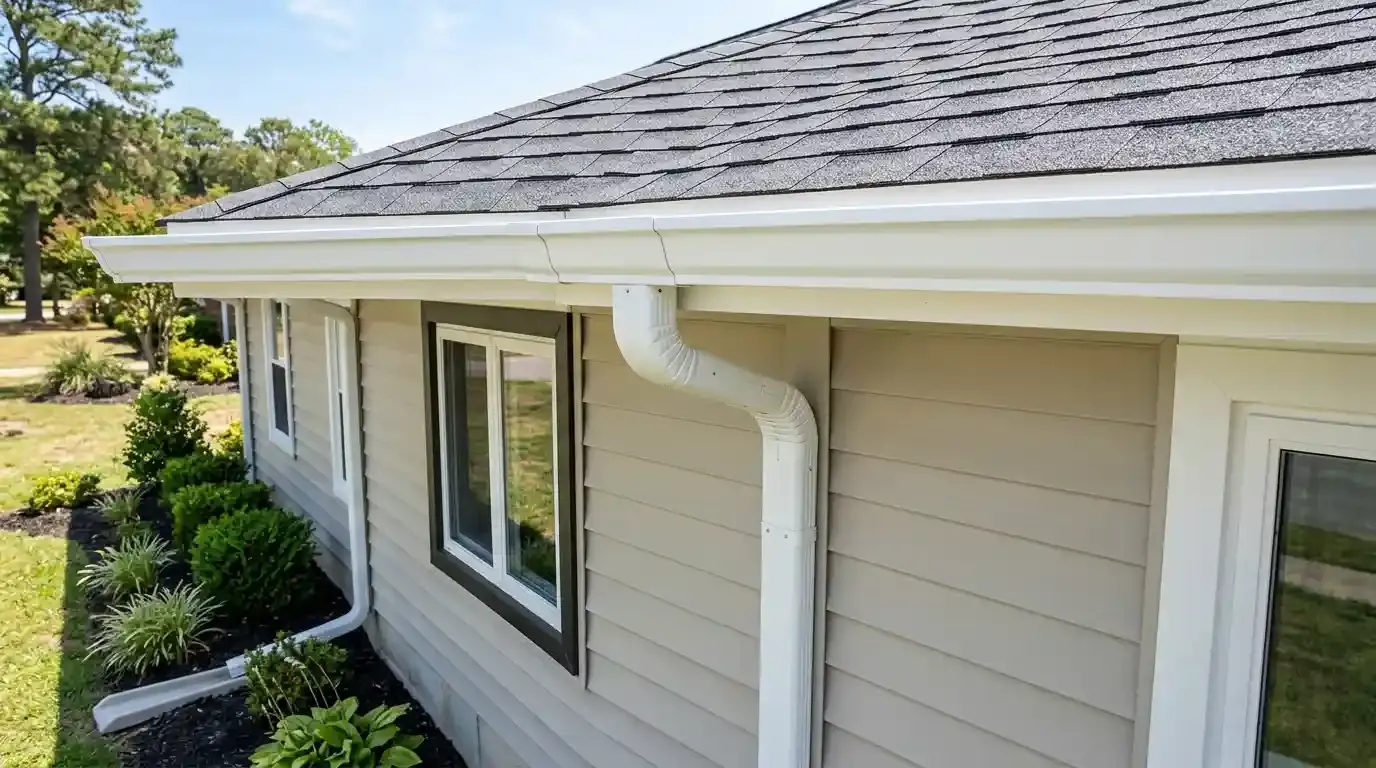
Gutters usually sag because the run is no longer supported, the attachment surface has weakened, water or debris is being held in a low section, or the system was not installed with adequate slope and support. A loose hanger can be a localized repair. Long sagging runs, pull-away, damaged fascia, standing water or repeated overflow need a broader review of the gutter, roof edge, outlets and downspouts.
What sagging looks like
From the ground, a sagging gutter may appear as:
- a visible dip between hangers;
- a run that slopes away from its outlet;
- water remaining in one section after rain;
- a front edge pulling away from the fascia;
- loose, missing or exposed fasteners; or
- overflow that begins at the low point.
A straight photograph can help document the symptom, but it cannot confirm the condition of the fascia, rafter tails, hidden hangers or roof edge. Do not climb to inspect a sagging gutter if access is wet, steep, tall or unsafe.
Common causes
| Possible cause | What it can do | What to verify |
|---|---|---|
| Loose or failed hanger | Allows a localized dip or pull-away | Surrounding gutter and fascia condition |
| Deteriorated fascia or subfascia | Leaves fasteners without a sound substrate | Related roof-edge or carpentry scope |
| Debris and standing water | Adds weight and keeps the run wet | Cleaning, outlet flow and slope |
| Long run or inadequate support | Produces movement between attachment points | Product and installation requirements |
| Poor slope or low point | Keeps water from reaching the outlet | Measured grade and outlet placement |
| Overflow or concentrated valley flow | Adds wetting and loading at one section | Roof catchment, valley, outlet and downspout |
| Impact or storm damage | Distorts the trough or attachment | Safe storm-damage inspection |
The symptom can have more than one cause.
Why sagging and overflow often appear together
A low point can hold water, while an inadequate outlet or restricted downspout can prevent that water from leaving. A gutter may also sag because it is repeatedly overloaded by a valley or because debris remains after storms. Read why gutters overflow before assuming that adding one hanger will solve the performance problem.
The repair scope should trace the roof-to-ground path. A new hanger cannot correct a buried discharge line that backs up, and a larger gutter cannot repair a failing fascia.
Repair, partial replacement or broader work
A localized sag may be repairable when the gutter, material, fasteners and attachment surface are sound. The work may involve cleaning, resetting slope, replacing a hanger, resealing a connection or replacing a short compatible section. Long sagging runs, widespread pull-away, corrosion, distorted profiles or deteriorated fascia may make partial replacement or a broader redesign more practical.
Use the repair-versus-replacement guide and replacement warning-sign guide to frame the decision. Related roof-edge, fascia, soffit, drainage or structural work should be identified separately.
What to document safely
From the ground, record the sag location, whether it occurs between supports or at a corner, whether water remains after rain, where overflow begins, whether the downspout flows and whether the fascia appears damaged. Include the story count, recent storm or roof work, tree debris and any previous repairs.
Do not stand beneath a visibly loose section during a storm or use the gutter as ladder support. Request a gutter repair estimate when the symptom is recurring or outside safe ground-level reach. Compare the gutter repair service, gutter installation service, and gutter cost guide according to the condition found.
Frequently asked questions
Can sagging gutters be rehung?
Sometimes. A localized hanger or attachment issue may be repairable when the gutter and fascia are sound. Widespread pull-away or substrate damage needs a broader scope.
Why do gutters sag after cleaning?
Cleaning may reveal an existing low point, loose hanger or damaged attachment. It can also show that water remains because the outlet, slope or downspout is restricted.
Can standing water make gutters sag?
It can add weight and keep the system loaded, but standing water may also be the result of sagging, poor slope, a blocked outlet or a downspout restriction.
Will more hangers fix sagging gutters?
Not automatically. More support may help a sound run, but it cannot correct deteriorated fascia, widespread corrosion, poor slope, valley overload or a blocked discharge path.
Do sagging gutters need replacement?
Not always. Localized damage may be repairable; long sagging runs, repeated pull-away, widespread corrosion or damaged attachment may make replacement worth comparing.
Can gutter guards cause sagging?
A guard may add weight or alter access, but sagging can have many causes. Review the gutter, guard, hangers, fascia and water path together.
What should a sagging-gutter estimate include?
It should identify measured repairs, support and attachment work, cleaning, slope or outlet changes, fascia exclusions, downspouts, removal, cleanup, price and written terms.
Sources
- U.S. Department of Energy: Gutters and Downspouts
- SMACNA Downspout & Gutter Sizing Calculator
- Texas Department of Insurance: Home Damaged by Storm FAQ
- U.S. Consumer Product Safety Commission: Outdoor Repairs Safety Checklist
Content review date: August 8, 2026.