
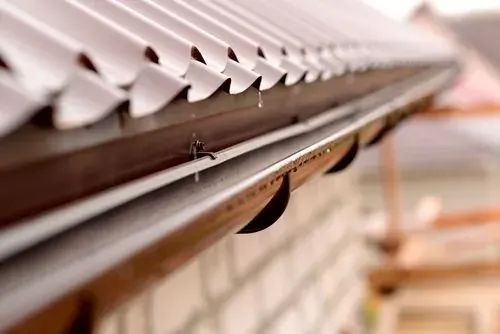
Yes. Gutter guards reduce selected debris entering the trough, but they do not make the roof-water system maintenance-free. Leaves, needles, seed pods, roof grit and organic material can collect on the guard surface, at edges, in valleys, around outlets or inside downspouts. The right maintenance plan depends on the guard type, trees, roof debris, rainfall, access and the condition of the underlying gutter.
What still needs inspection
- guard surface: leaves, needles, seed pods, roof grit and moss-like buildup;
- leading edge: debris that blocks or redirects water entry;
- valleys and transitions: concentrated flow or debris dams;
- gutter body: standing water, corrosion, sagging or open joints;
- outlets and downspouts: restricted flow or trapped debris; and
- discharge endpoint: extension, splash block, buried line or ponding.
A guard can hide a problem below the surface. A gutter that overflows with the guard in place needs a full flow-path review, not simply a promise that the product is working.
Maintenance differs by guard category
Screen and mesh products can load with leaves and roof grit on top. Micro-mesh may keep finer debris out of the trough but still needs surface and edge inspection. Solid-surface products can accumulate debris along the nose or at valleys. Brush and foam inserts can retain wet organic material inside the gutter.
The gutter guard types guide compares categories. A product’s marketing label does not establish how it should be cleaned, what tools are allowed or whether removal is required. Follow the specific manufacturer instructions and the installer’s written scope.
When to schedule attention
Use symptoms and conditions rather than one universal interval. More frequent checks may be sensible where there are mature trees, pine needles, roof grit, steep or complex roofs, heavy storms, prior clogs or a history of overflow. Check before periods of heavy rain and after major wind when debris may have shifted.
This page addresses guard maintenance; the how-often gutters should be cleaned guide addresses schedule decisions for the gutter system as a whole.
Safety limits
Do not walk a roof or climb an unsafe ladder to clean a guard. Second-story, steep, wet, power-line-adjacent, damaged or difficult-to-reach systems should be evaluated by a qualified professional. Ground-level photos and observations are useful, but a hidden guard surface is not a reason to improvise access.
The gutter-cleaning safety guide explains safer limits. Do not pressure-wash a guard or use a tool unless the product instructions and site conditions allow it.
Cleaning, repair or replacement?
Cleaning is appropriate when debris restricts the guard, gutter, outlet or downspout and the system remains sound. Repair is needed when the guard is displaced, the gutter sags, joints leak or the outlet remains blocked. Replacement or removal may deserve comparison when the guard is incompatible, deteriorated, difficult to maintain or contributing to recurring overflow.
The gutter guard value guide helps evaluate the maintenance tradeoff. Request a guard cleaning or inspection estimate with the guard type, story count, tree conditions and symptom location. Compare the gutter guard service, gutter cleaning service, and micro-mesh versus screen guide when the product or condition is unclear.
Frequently asked questions
Are gutter guards maintenance-free?
No. Guard surfaces, edges, valleys, gutters, outlets and downspouts still need inspection and occasional cleaning or repair.
What collects on top of gutter guards?
Leaves, needles, seed pods, roof grit, moss-like organic material and fine debris can collect depending on the roof and surrounding trees.
Do micro-mesh guards need cleaning?
Yes. Fine openings may reduce debris entering the trough, but the surface, edges, valleys, outlets and downspouts still need attention.
Can I clean gutter guards from the ground?
You can observe them from safe ground, but cleaning depends on the product and access. Do not climb a wet roof or unsafe ladder; follow manufacturer instructions or use qualified help.
How often should gutter guards be cleaned?
There is no universal interval. Tree cover, roof grit, rainfall, guard type, prior clogs and access change the schedule. Inspect before heavy rain and after major storms.
Can gutter guards cause overflow?
They can affect water entry when the surface loads with debris, the product does not fit, valleys concentrate flow or the underlying gutter and downspouts are inadequate.
What should a guard-cleaning estimate include?
It should identify the guard type, accessible footage, surface and gutter cleaning, outlet and downspout checks, repairs, disposal, access limits, cleanup, price and exclusions.
Sources
- GAF Technical Bulletin R-113: Gutter Covers and Shingles
- U.S. Department of Energy: Gutters and Downspouts
- Texas Department of Insurance: Prepare for a Hurricane or Tropical Storm
- U.S. Consumer Product Safety Commission: Outdoor Repairs Safety Checklist
Content review date: August 8, 2026.