
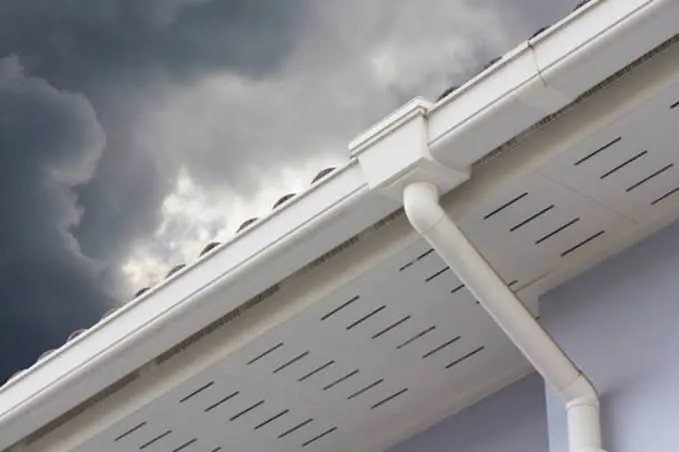
Gutter guards do not guarantee overflow prevention during heavy rain. A guard becomes part of the water-entry surface, so performance depends on the product, roof pitch, valleys, surface debris, gutter slope, outlet placement, downspouts and discharge. A guard that works on a clean straight run may behave differently when intense rain reaches a valley or the surface is loaded with roof grit.
What heavy rain exposes
| Flow condition | Why the guard matters | What else must be checked |
|---|---|---|
| Long smooth roof plane | Water may reach the eave quickly | Gutter capacity, slope and outlet spacing |
| Roof valley | Runoff is concentrated at a small area | Valley transition, guard edge and downspout |
| Fine roof grit | Surface openings can load over time | Cleaning access and water-entry path |
| Leaves on the guard | Water may be redirected over the front | Surface maintenance and tree conditions |
| Intense rainfall | Entry and conveyance limits are tested | Gutter, outlet, downspout and discharge |
| Restricted endpoint | Water backs up through the system | Extension, buried line or grade |
The guard is one component. Replacing it cannot correct every upstream or downstream limitation.
Surface design and water entry
Screens, mesh, micro-mesh, solid-surface covers, brush and foam inserts expose water to different surfaces. A product may allow water through openings, across a mesh, or around a shaped edge. Debris, roof angle, rainfall intensity and surface tension can change that behavior.
The gutter guard types guide compares categories, while micro-mesh versus screens narrows the two-category choice. Use the actual product model and installation documents, not a generic category promise.
Valleys and concentrated flow
Valleys deserve specific attention because a large roof area may send water to a short gutter segment. A guard edge, seam, corner or transition can redirect water when the flow is concentrated. Ask whether the estimate identifies valley locations, how the guard meets the roof edge, how water enters at those locations and whether the downspout can convey the projected flow.
A short demonstration away from the valley does not prove performance at the valley. The complete heavy-rain gutter guide explains roof catchment, gutters, outlets, downspouts and discharge without treating guards as a substitute for system design.
Cleaning and surface loading
Heavy rain can move roof grit and organic material toward the guard. Leaves may remain on top, while fine material can collect in mesh openings or at the edge. A guard can reduce trough debris and still require surface cleaning, outlet checks and downspout maintenance.
Check before periods of heavy rain and after major wind when debris may have shifted. The gutter-cleaning service page and guard-value guide help set realistic maintenance expectations.
How to compare heavy-rain guard proposals
Ask for the exact manufacturer and model, roof and gutter compatibility, valley treatment, water-entry explanation, surface-cleaning method, pre-installation cleaning or repair, outlet and downspout scope, attachment, roof-edge boundaries, product documents, exclusions, price and written workmanship terms.
Request a gutter guard estimate with safe ground photos, tree conditions, roof type, story count, existing guard details and the location of any overflow. No product can be selected responsibly from rainfall alone. The gutter guard service page covers installation scope after the existing system is evaluated.
Frequently asked questions
Are gutter guards good for heavy rain?
They may work on some systems, but no guard guarantees overflow prevention. Roof pitch, valleys, surface loading, gutter slope, outlets, downspouts and discharge determine performance.
Can gutter guards make heavy-rain overflow worse?
They can affect water entry when the surface is loaded, the product does not fit, a valley concentrates flow or the underlying system is inadequate.
Which gutter guard is best for heavy rain?
There is no universal best type. Compare the specific product, roof, valley flow, gutter condition, cleaning access, outlets and downspouts.
Do micro-mesh guards stop water during intense rain?
Micro-mesh may admit water through fine openings, but surface loading, pitch, valleys, rainfall and downstream capacity still need evaluation.
Do gutter guards still need cleaning in heavy-rain areas?
Yes. Leaves, needles, roof grit and organic material can collect on surfaces, at edges, in valleys, outlets and downspouts.
Will a gutter guard fix overflow at a roof valley?
Not automatically. Valley concentration may require changes to gutter, outlet, downspout, slope or the guard transition; inspect the full flow path.
What should a heavy-rain guard estimate include?
It should identify the product, valley and roof-edge treatment, water-entry plan, existing-gutter condition, outlets, downspouts, cleaning access, exclusions, price and written terms.
Sources
- GAF Technical Bulletin R-113: Gutter Covers and Shingles
- NOAA Atlas 14 precipitation-frequency point query near central Katy
- SMACNA Downspout & Gutter Sizing Calculator
- Texas Department of Insurance: Prepare for a Hurricane or Tropical Storm
Content review date: August 8, 2026.